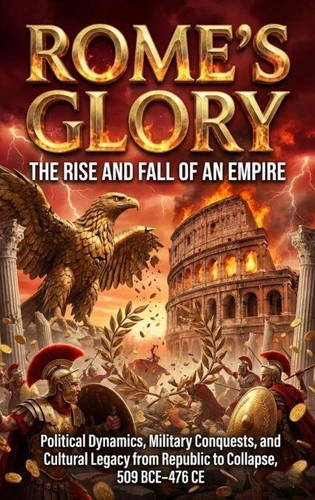
Rome's Glory: The Rise and Fall of an Empire. Subtitle Political Dynamics, Military Conquests, and Cultural Legacy from Republic to Collapse, 509 BCE-476 CE
Par :Formats :
Disponible dans votre compte client Decitre ou Furet du Nord dès validation de votre commande. Le format ePub est :
- Compatible avec une lecture sur My Vivlio (smartphone, tablette, ordinateur)
- Compatible avec une lecture sur liseuses Vivlio
- Pour les liseuses autres que Vivlio, vous devez utiliser le logiciel Adobe Digital Edition. Non compatible avec la lecture sur les liseuses Kindle, Remarkable et Sony
 , qui est-ce ?
Notre partenaire de plateforme de lecture numérique où vous retrouverez l'ensemble de vos ebooks gratuitement
Pour en savoir plus sur nos ebooks, consultez notre aide en ligne ici
C'est si simple ! Lisez votre ebook avec l'app Vivlio sur votre tablette, mobile ou ordinateur :

- Nombre de pages181
- FormatePub
- ISBN978-3-565-25082-0
- EAN9783565250820
- Date de parution16/02/2026
- Protection num.pas de protection
- Taille2 Mo
- Infos supplémentairesepub
- ÉditeurEmphaloz Publishing House
Résumé
From the legendary founding on the Tiber's banks to the final collapse of imperial authority, Rome's trajectory shaped the Western world for millennia. This comprehensive history examines how a small Italian city-state transformed into history's most influential empire, then fragmented under its own weight.
Drawing on archaeological evidence, contemporary accounts, and modern scholarship, the narrative traces Rome's evolution through distinct phases: the republican experiment in shared governance, the imperial expansion that brought unprecedented wealth and diversity, and the gradual disintegration that redefined European civilization.
Key turning points receive careful analysis-the Punic Wars that established Mediterranean dominance, Caesar's crossing of the Rubicon, Augustus's constitutional settlement, the crisis of the third century, and the empire's division into eastern and western spheres. Beyond military campaigns and political intrigue, the book explores daily life, engineering achievements, legal innovations, and religious transformations that made Rome's cultural influence endure long after its legions disbanded.
The rise of Christianity, administrative reforms, and the complex relationship between center and periphery reveal an empire constantly adapting to internal pressures and external threats.
Key turning points receive careful analysis-the Punic Wars that established Mediterranean dominance, Caesar's crossing of the Rubicon, Augustus's constitutional settlement, the crisis of the third century, and the empire's division into eastern and western spheres. Beyond military campaigns and political intrigue, the book explores daily life, engineering achievements, legal innovations, and religious transformations that made Rome's cultural influence endure long after its legions disbanded.
The rise of Christianity, administrative reforms, and the complex relationship between center and periphery reveal an empire constantly adapting to internal pressures and external threats.
A propos de Alina Frost


















8,99 €