Alina Frost is a nonfiction author who writes about self-discovery, emotional strength, and modern life challenges. Her work combines gentle reflection with practical insight, encouraging readers to build confidence, resilience, and a deeper understanding of themselves.
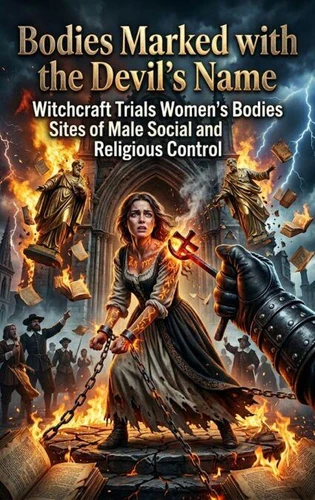
Bodies Marked with the Devil's Name. Witchcraft Trials Women's Bodies as Sites of Male Social and Religious Control
Par :Formats :
Disponible dans votre compte client Decitre ou Furet du Nord dès validation de votre commande. Le format ePub est :
- Compatible avec une lecture sur My Vivlio (smartphone, tablette, ordinateur)
- Compatible avec une lecture sur liseuses Vivlio
- Pour les liseuses autres que Vivlio, vous devez utiliser le logiciel Adobe Digital Edition. Non compatible avec la lecture sur les liseuses Kindle, Remarkable et Sony
 , qui est-ce ?
Notre partenaire de plateforme de lecture numérique où vous retrouverez l'ensemble de vos ebooks gratuitement
Pour en savoir plus sur nos ebooks, consultez notre aide en ligne ici
C'est si simple ! Lisez votre ebook avec l'app Vivlio sur votre tablette, mobile ou ordinateur :

- Nombre de pages214
- FormatePub
- ISBN978-3-565-46157-8
- EAN9783565461578
- Date de parution26/05/2026
- Protection num.pas de protection
- Taille2 Mo
- Infos supplémentairesepub
- ÉditeurEmphaloz Publishing House
Résumé
This book investigates how witchcraft trials turned women's bodies into battlegrounds, tracing the ways in which accusations of magic, possession, and heresy were used to police female autonomy, sexuality, and knowledge. It examines early-modern Europe and colonial North America as overlapping spaces where religious doctrine, patriarchal law, and village fear converged on the figure of the "witch, " exposing how women's behavior, speech, and bodies became the primary evidence in trials that were less about supernatural belief than about social discipline.
Drawing on inquisitorial records, trial transcripts, and sermons, the book reconstructs the mechanisms through which women's bodies were interrogated: invasive examinations for "witches' marks, " the policing of midwifery and herbal knowledge, the use of torture to elicit confessions, and the theatrical staging of public punishments designed to reinforce male authority in both church and household.
It also traces how women who were economically independent, verbally assertive, or sexually nonconforming were disproportionately targeted, showing how the witch label functioned as a sanction against any woman who seemed to threaten the boundaries of prescribed femininity.
It also traces how women who were economically independent, verbally assertive, or sexually nonconforming were disproportionately targeted, showing how the witch label functioned as a sanction against any woman who seemed to threaten the boundaries of prescribed femininity.