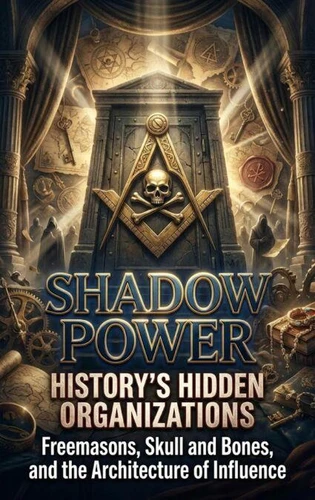
Shadow Power: History's Hidden Organizations. Freemasons, Skull and Bones, and the Architecture of Influence
Par :Formats :
Disponible dans votre compte client Decitre ou Furet du Nord dès validation de votre commande. Le format ePub est :
- Compatible avec une lecture sur My Vivlio (smartphone, tablette, ordinateur)
- Compatible avec une lecture sur liseuses Vivlio
- Pour les liseuses autres que Vivlio, vous devez utiliser le logiciel Adobe Digital Edition. Non compatible avec la lecture sur les liseuses Kindle, Remarkable et Sony
 , qui est-ce ?
Notre partenaire de plateforme de lecture numérique où vous retrouverez l'ensemble de vos ebooks gratuitement
Pour en savoir plus sur nos ebooks, consultez notre aide en ligne ici
C'est si simple ! Lisez votre ebook avec l'app Vivlio sur votre tablette, mobile ou ordinateur :

- Nombre de pages253
- FormatePub
- ISBN978-3-565-27997-5
- EAN9783565279975
- Date de parution27/02/2026
- Protection num.pas de protection
- Taille2 Mo
- Infos supplémentairesepub
- ÉditeurEmphaloz Publishing House
Résumé
Beneath the visible structures of political and economic power, a parallel world of organized secrecy has operated for centuries. Shadow Power examines the documented history of the world's most consequential secret societies-not through the lens of conspiracy, but through the archival record: founding charters, membership rosters, internal correspondence, and the verified biographical trails of individuals who moved between hidden organizations and the highest offices of state, finance, and military command.
Drawing on declassified intelligence files, Masonic archives, university historical records, and the scholarship of historians specializing in elite organization and political sociology, each chapter reconstructs a distinct society-the Freemasons, the Rosicrucians, Skull and Bones, Opus Dei, the Bilderberg Group, and others-examining what they actually believed, who actually joined, and what influence, if any, they demonstrably exercised over political and institutional outcomes.
The book draws a careful distinction between documented network influence and the elaborate mythologies that have grown around each organization, treating both as historically significant phenomena worthy of serious analysis. The final section examines why secrecy itself functions as a form of power-how the mere existence of hidden organization shapes public behavior, institutional trust, and political culture, regardless of what those organizations actually do.
Shadow Power is a history of the spaces between official records: rigorous, evidence-based, and written for readers who understand that the most important historical questions are often the ones that official archives were designed not to answer.
The book draws a careful distinction between documented network influence and the elaborate mythologies that have grown around each organization, treating both as historically significant phenomena worthy of serious analysis. The final section examines why secrecy itself functions as a form of power-how the mere existence of hidden organization shapes public behavior, institutional trust, and political culture, regardless of what those organizations actually do.
Shadow Power is a history of the spaces between official records: rigorous, evidence-based, and written for readers who understand that the most important historical questions are often the ones that official archives were designed not to answer.
A propos de Alina Frost


















8,99 €