Nouveauté
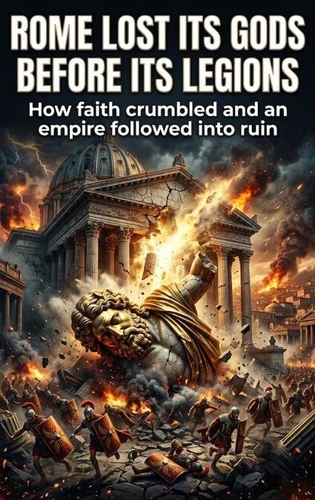
Rome lost its gods before its legions. How faith crumbled and an empire followed into ruin
Par :Formats :
Disponible dans votre compte client Decitre ou Furet du Nord dès validation de votre commande. Le format ePub est :
- Compatible avec une lecture sur My Vivlio (smartphone, tablette, ordinateur)
- Compatible avec une lecture sur liseuses Vivlio
- Pour les liseuses autres que Vivlio, vous devez utiliser le logiciel Adobe Digital Edition. Non compatible avec la lecture sur les liseuses Kindle, Remarkable et Sony
 , qui est-ce ?
Notre partenaire de plateforme de lecture numérique où vous retrouverez l'ensemble de vos ebooks gratuitement
Pour en savoir plus sur nos ebooks, consultez notre aide en ligne ici
C'est si simple ! Lisez votre ebook avec l'app Vivlio sur votre tablette, mobile ou ordinateur :

- Nombre de pages236
- FormatePub
- ISBN978-3-565-54759-3
- EAN9783565547593
- Date de parution08/07/2026
- Protection num.pas de protection
- Taille653 Ko
- Infos supplémentairesepub
- ÉditeurEmphaloz Publishing House
Résumé
Before the barbarians crossed the Rhine, before the last emperor fled, Rome had already ceased to function. This book argues that the Empire's decline was not primarily a military defeat but an administrative one-a slow disintegration of the systems that collected taxes, maintained roads, moved supplies, and kept provinces loyal. Drawing on epigraphic and archaeological evidence, it reconstructs the daily machinery of Roman governance and shows where cracks first appeared: in the gap between law and enforcement, between imperial decree and local compliance.
The narrative follows the lives of mid-level officials, provincial governors, and legionary quartermasters whose decisions shaped the Empire more than any single emperor. It traces how corruption became structural, how information networks failed, and how the distance between Rome and its frontiers grew too vast for command to mean anything. The book also examines how the Diocletianic reforms, designed to save the Empire, instead hardened its arteries and made collapse inevitable.
A sobering study of how great powers fail not when they are conquered, but when they can no longer govern themselves.
The narrative follows the lives of mid-level officials, provincial governors, and legionary quartermasters whose decisions shaped the Empire more than any single emperor. It traces how corruption became structural, how information networks failed, and how the distance between Rome and its frontiers grew too vast for command to mean anything. The book also examines how the Diocletianic reforms, designed to save the Empire, instead hardened its arteries and made collapse inevitable.
A sobering study of how great powers fail not when they are conquered, but when they can no longer govern themselves.
A propos de Tyler Ashford









0,49 €