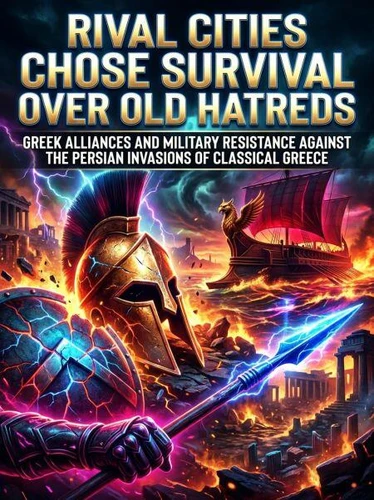
Rival Cities Chose Survival Over Old Hatreds. Greek alliances and military resistance against the Persian invasions of classical Greece
Par :Formats :
Disponible dans votre compte client Decitre ou Furet du Nord dès validation de votre commande. Le format ePub est :
- Compatible avec une lecture sur My Vivlio (smartphone, tablette, ordinateur)
- Compatible avec une lecture sur liseuses Vivlio
- Pour les liseuses autres que Vivlio, vous devez utiliser le logiciel Adobe Digital Edition. Non compatible avec la lecture sur les liseuses Kindle, Remarkable et Sony
 , qui est-ce ?
Notre partenaire de plateforme de lecture numérique où vous retrouverez l'ensemble de vos ebooks gratuitement
Pour en savoir plus sur nos ebooks, consultez notre aide en ligne ici
C'est si simple ! Lisez votre ebook avec l'app Vivlio sur votre tablette, mobile ou ordinateur :

- Nombre de pages208
- FormatePub
- ISBN978-3-565-48598-7
- EAN9783565485987
- Date de parution08/06/2026
- Protection num.pas de protection
- Taille1 Mo
- Infos supplémentairesepub
- ÉditeurEmphaloz Publishing House
Résumé
The Greek city-states spent generations divided by rivalry, trade competition, and political distrust. Yet the expansion of Persian power across the eastern Mediterranean forced fragmented poleis to confront a common threat capable of ending their independence entirely.
This account explores how Greek political identity evolved during the Persian Wars. Athens, Sparta, and smaller city-states formed fragile alliances despite profound ideological and strategic differences.
Shared defense against imperial invasion gradually fostered a broader sense of Hellenic identity that extended beyond local loyalties. The book also examines the military strategies that shaped decisive battles such as Marathon, Thermopylae, and Salamis. Spartan hoplite discipline, Athenian naval coordination, and geographic advantage combined to counter the logistical scale of Persian warfare.
Maritime supply lines and coastal maneuvering became essential factors in determining the outcome of the conflict. The Persian Wars emerge here not only as military confrontation, but as a turning point in how divided societies construct political unity under external pressure.
Shared defense against imperial invasion gradually fostered a broader sense of Hellenic identity that extended beyond local loyalties. The book also examines the military strategies that shaped decisive battles such as Marathon, Thermopylae, and Salamis. Spartan hoplite discipline, Athenian naval coordination, and geographic advantage combined to counter the logistical scale of Persian warfare.
Maritime supply lines and coastal maneuvering became essential factors in determining the outcome of the conflict. The Persian Wars emerge here not only as military confrontation, but as a turning point in how divided societies construct political unity under external pressure.