Known for narrative histories about trade empires, shipping routes, and financial systems.
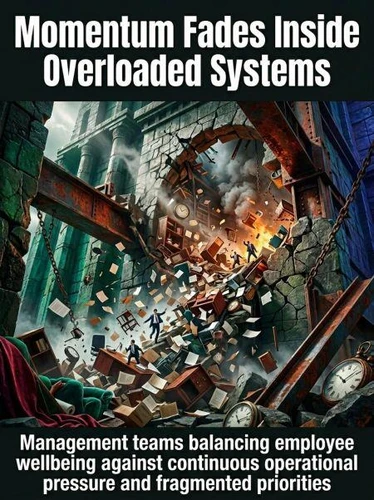
Momentum Fades Inside Overloaded Systems. Management teams balancing employee wellbeing against continuous operational pressure and fragmented priorities
Par :Formats :
Disponible dans votre compte client Decitre ou Furet du Nord dès validation de votre commande. Le format ePub est :
- Compatible avec une lecture sur My Vivlio (smartphone, tablette, ordinateur)
- Compatible avec une lecture sur liseuses Vivlio
- Pour les liseuses autres que Vivlio, vous devez utiliser le logiciel Adobe Digital Edition. Non compatible avec la lecture sur les liseuses Kindle, Remarkable et Sony
 , qui est-ce ?
Notre partenaire de plateforme de lecture numérique où vous retrouverez l'ensemble de vos ebooks gratuitement
Pour en savoir plus sur nos ebooks, consultez notre aide en ligne ici
C'est si simple ! Lisez votre ebook avec l'app Vivlio sur votre tablette, mobile ou ordinateur :

- Nombre de pages144
- FormatePub
- ISBN978-3-565-48085-2
- EAN9783565480852
- Date de parution06/06/2026
- Protection num.pas de protection
- Taille1 Mo
- Infos supplémentairesepub
- ÉditeurEmphaloz Publishing House
Résumé
Many management systems depend on constant coordination. Leaders align departments, monitor performance, resolve operational conflicts, and maintain communication across expanding organizational structures. Over time, however, the effort required to sustain alignment begins consuming the capacity needed for meaningful execution.
This book examines how management pressure accumulates inside modern corporate environments.
Team leaders operate between strategic expectations from above and emotional demands from below. They absorb uncertainty while maintaining delivery timelines, employee stability, and operational continuity. The book analyzes why overloaded workflows gradually reduce decision quality and weaken organizational trust. Communication multiplies while accountability diffuses. Meetings expand while ownership contracts.
Managers remain highly active but progressively less capable of protecting focus and direction for their teams. Through organizational management and workplace leadership frameworks, the discussion explores how companies unintentionally create burnout conditions through fragmented priorities, constant urgency, and excessive collaboration requirements. Instead of treating exhaustion as a personal weakness, the book frames burnout as a structural signal within overloaded systems.
Sustainable performance depends on reducing friction around attention, authority, and execution. As European organizations adapt to hybrid work models, labor shortages, and accelerating operational complexity, protecting managerial effectiveness becomes central to long-term organizational stability and employee retention.
Team leaders operate between strategic expectations from above and emotional demands from below. They absorb uncertainty while maintaining delivery timelines, employee stability, and operational continuity. The book analyzes why overloaded workflows gradually reduce decision quality and weaken organizational trust. Communication multiplies while accountability diffuses. Meetings expand while ownership contracts.
Managers remain highly active but progressively less capable of protecting focus and direction for their teams. Through organizational management and workplace leadership frameworks, the discussion explores how companies unintentionally create burnout conditions through fragmented priorities, constant urgency, and excessive collaboration requirements. Instead of treating exhaustion as a personal weakness, the book frames burnout as a structural signal within overloaded systems.
Sustainable performance depends on reducing friction around attention, authority, and execution. As European organizations adapt to hybrid work models, labor shortages, and accelerating operational complexity, protecting managerial effectiveness becomes central to long-term organizational stability and employee retention.
A propos de Tyler Ashford





9,99 €