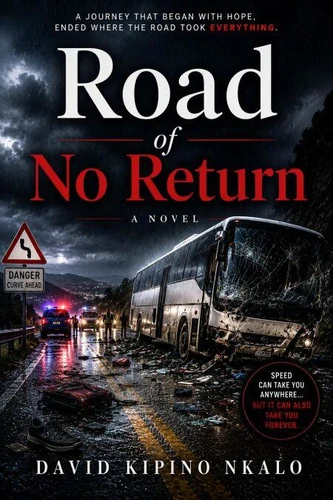
Road of No Return is a powerful cautionary novel centered on Haraka, a confident and highly skilled bus driver whose name-meaning "speed" in Swahili-reflects both his strength and his greatest flaw. Set along the highway beyond Nairobi, the story follows a night journey that begins as a routine passenger trip but gradually transforms into a life-altering tragedy. As the bus travels through rain, darkness, and competing pressures on the road, Haraka becomes increasingly driven by urgency, competition, and external expectations.
A silent rivalry with another bus pushes him into deeper risk-taking, while road signs, passenger concerns, and experienced warnings are repeatedly ignored or overridden by ambition and focus on speed. Inside the bus, passengers represent ordinary lives-children, parents, elders-each unaware that their fate is tied to a chain of seconds, decisions, and distractions unfolding at the front. A mix of warnings, fatigue, and momentary distraction builds tension until a dangerous curve becomes the turning point of irreversible consequence.
A critical second of misjudgment leads to a catastrophic event that changes everything. What follows is not only physical aftermath but emotional, social, and legal collapse. Survivors struggle with trauma, families face devastating loss, and news spreads rapidly, turning private lives into public headlines. Haraka himself becomes the center of investigation, justice, and inner torment. The story shifts from motion to reflection as he confronts accountability, memory, and the permanent weight of a single moment on the road.
The novel ultimately delivers a strong road safety message: speed, distraction, and disregard for warnings can turn ordinary journeys into irreversible tragedy. It is a deeply human exploration of responsibility, survival, grief, and the unforgiving truth that some roads, once crossed wrongly, offer no return.
Road of No Return is a powerful cautionary novel centered on Haraka, a confident and highly skilled bus driver whose name-meaning "speed" in Swahili-reflects both his strength and his greatest flaw. Set along the highway beyond Nairobi, the story follows a night journey that begins as a routine passenger trip but gradually transforms into a life-altering tragedy. As the bus travels through rain, darkness, and competing pressures on the road, Haraka becomes increasingly driven by urgency, competition, and external expectations.
A silent rivalry with another bus pushes him into deeper risk-taking, while road signs, passenger concerns, and experienced warnings are repeatedly ignored or overridden by ambition and focus on speed. Inside the bus, passengers represent ordinary lives-children, parents, elders-each unaware that their fate is tied to a chain of seconds, decisions, and distractions unfolding at the front. A mix of warnings, fatigue, and momentary distraction builds tension until a dangerous curve becomes the turning point of irreversible consequence.
A critical second of misjudgment leads to a catastrophic event that changes everything. What follows is not only physical aftermath but emotional, social, and legal collapse. Survivors struggle with trauma, families face devastating loss, and news spreads rapidly, turning private lives into public headlines. Haraka himself becomes the center of investigation, justice, and inner torment. The story shifts from motion to reflection as he confronts accountability, memory, and the permanent weight of a single moment on the road.
The novel ultimately delivers a strong road safety message: speed, distraction, and disregard for warnings can turn ordinary journeys into irreversible tragedy. It is a deeply human exploration of responsibility, survival, grief, and the unforgiving truth that some roads, once crossed wrongly, offer no return.


 , qui est-ce ?