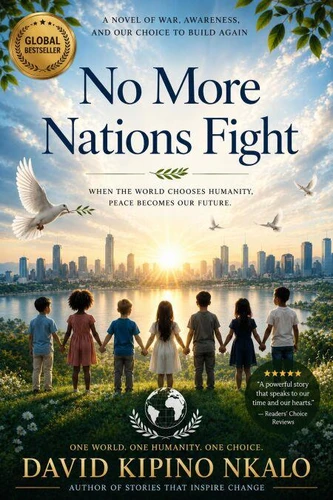
No More Nations Fight is a powerful global literary novel that follows the emotional collapse and transformation of a world consumed by modern warfare. Through interconnected stories of children, teachers, soldiers, journalists, and leaders, the novel explores how conflict reshapes humanity-and how humanity eventually resists being reshaped by it. The story begins in cities shattered by war, where innocent civilians, especially children, endure loss, displacement, and survival amid destruction.
Amid the chaos, voices emerge that refuse to be silenced: a teacher who continues educating in ruins, a soldier who questions obedience, a journalist who breaks down while witnessing truth, and children who begin to speak directly to nations. As the violence escalates, the world becomes globally connected through instant visibility. Images of suffering and resistance spread across continents, triggering synchronized emotional responses in crowds without borders.
Movements arise not through political systems but through shared human witnessing. The word "Enough" spreads across generations, signaling a collective refusal to accept endless war. Leaders behind closed doors struggle to maintain control as traditional authority weakens under global awareness and moral pressure. Soldiers begin hesitating, then lowering weapons, not through defeat but through recognition of shared humanity.
The war does not end in a single declaration-it dissolves through widespread refusal, emotional saturation, and moral awakening. In the aftermath, the novel shifts into rebuilding: children return to learning, communities reconstruct shelters, and memorials emerge to honor loss. A symbolic memorial of empty shoes becomes a reminder of lives interrupted and futures still owed. Ultimately, No More Nations Fight is not only a story about war-it is about transformation.
It asks what happens when humanity collectively decides that suffering is no longer acceptable, and it concludes with a powerful message: the future is not given, it is built, and it must be built differently for the generations that follow.
No More Nations Fight is a powerful global literary novel that follows the emotional collapse and transformation of a world consumed by modern warfare. Through interconnected stories of children, teachers, soldiers, journalists, and leaders, the novel explores how conflict reshapes humanity-and how humanity eventually resists being reshaped by it. The story begins in cities shattered by war, where innocent civilians, especially children, endure loss, displacement, and survival amid destruction.
Amid the chaos, voices emerge that refuse to be silenced: a teacher who continues educating in ruins, a soldier who questions obedience, a journalist who breaks down while witnessing truth, and children who begin to speak directly to nations. As the violence escalates, the world becomes globally connected through instant visibility. Images of suffering and resistance spread across continents, triggering synchronized emotional responses in crowds without borders.
Movements arise not through political systems but through shared human witnessing. The word "Enough" spreads across generations, signaling a collective refusal to accept endless war. Leaders behind closed doors struggle to maintain control as traditional authority weakens under global awareness and moral pressure. Soldiers begin hesitating, then lowering weapons, not through defeat but through recognition of shared humanity.
The war does not end in a single declaration-it dissolves through widespread refusal, emotional saturation, and moral awakening. In the aftermath, the novel shifts into rebuilding: children return to learning, communities reconstruct shelters, and memorials emerge to honor loss. A symbolic memorial of empty shoes becomes a reminder of lives interrupted and futures still owed. Ultimately, No More Nations Fight is not only a story about war-it is about transformation.
It asks what happens when humanity collectively decides that suffering is no longer acceptable, and it concludes with a powerful message: the future is not given, it is built, and it must be built differently for the generations that follow.

 , qui est-ce ?