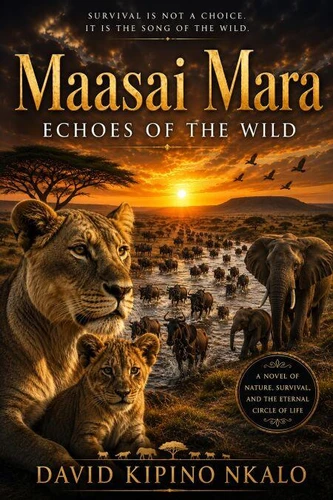
Maasai Mara: Echoes of the Wild is a powerful literary exploration of life, survival, and balance within the untamed beauty of the Maasai Mara National Reserve. The novel presents the savannah not merely as a setting, but as a living force-one that breathes, remembers, and shapes every creature that exists within it. Through a series of interconnected chapters, the story follows the eternal rhythms of the wild: hunting and migration, birth and loss, dominance and vulnerability.
Lions represent leadership and the brutal clarity of survival; cheetahs embody precision and fleeting opportunity; elephants carry memory and ancient wisdom; rhinos symbolize fading strength and ecological fragility; and wildebeest reflect collective endurance through migration and sacrifice. At the heart of the narrative is the idea that survival in the savannah is never individual-it is systemic.
Every chase begins long before it is seen, and every ending becomes the beginning of another cycle. The river crossings, predator hunts, and seasonal movements reveal a world governed by instinct rather than emotion, where weakness, timing, and adaptation determine fate. Human presence is woven through the voice of the Maasai warriors, who live alongside the wild not as rulers, but as witnesses and participants in the same fragile ecosystem.
Their traditions, chants, and observations reflect a deep understanding that land is not owned, but shared and respected. As the story progresses, the savannah itself begins to feel like a character-changing, responding, and echoing the actions of all who move across it. Shifts in climate, fragmentation of migration, and the disappearance of once-powerful species highlight the delicate balance holding the ecosystem together.
Ultimately, Echoes of the Wild is not just about animals or people. It is about continuity. It is a meditation on how life persists through cycles of struggle, how memory is carried through land and instinct, and how every voice in the wild becomes part of an endless echo that never truly fades.
Maasai Mara: Echoes of the Wild is a powerful literary exploration of life, survival, and balance within the untamed beauty of the Maasai Mara National Reserve. The novel presents the savannah not merely as a setting, but as a living force-one that breathes, remembers, and shapes every creature that exists within it. Through a series of interconnected chapters, the story follows the eternal rhythms of the wild: hunting and migration, birth and loss, dominance and vulnerability.
Lions represent leadership and the brutal clarity of survival; cheetahs embody precision and fleeting opportunity; elephants carry memory and ancient wisdom; rhinos symbolize fading strength and ecological fragility; and wildebeest reflect collective endurance through migration and sacrifice. At the heart of the narrative is the idea that survival in the savannah is never individual-it is systemic.
Every chase begins long before it is seen, and every ending becomes the beginning of another cycle. The river crossings, predator hunts, and seasonal movements reveal a world governed by instinct rather than emotion, where weakness, timing, and adaptation determine fate. Human presence is woven through the voice of the Maasai warriors, who live alongside the wild not as rulers, but as witnesses and participants in the same fragile ecosystem.
Their traditions, chants, and observations reflect a deep understanding that land is not owned, but shared and respected. As the story progresses, the savannah itself begins to feel like a character-changing, responding, and echoing the actions of all who move across it. Shifts in climate, fragmentation of migration, and the disappearance of once-powerful species highlight the delicate balance holding the ecosystem together.
Ultimately, Echoes of the Wild is not just about animals or people. It is about continuity. It is a meditation on how life persists through cycles of struggle, how memory is carried through land and instinct, and how every voice in the wild becomes part of an endless echo that never truly fades.


 , qui est-ce ?