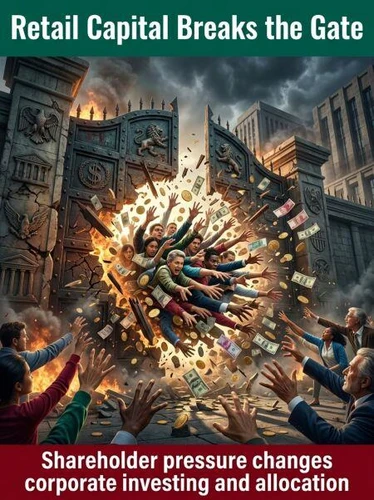
Retail Capital Breaks the Gate. Shareholder pressure changes corporate investing and allocation
Par :Formats :
Disponible dans votre compte client Decitre ou Furet du Nord dès validation de votre commande. Le format ePub est :
- Compatible avec une lecture sur My Vivlio (smartphone, tablette, ordinateur)
- Compatible avec une lecture sur liseuses Vivlio
- Pour les liseuses autres que Vivlio, vous devez utiliser le logiciel Adobe Digital Edition. Non compatible avec la lecture sur les liseuses Kindle, Remarkable et Sony
 , qui est-ce ?
Notre partenaire de plateforme de lecture numérique où vous retrouverez l'ensemble de vos ebooks gratuitement
Pour en savoir plus sur nos ebooks, consultez notre aide en ligne ici
C'est si simple ! Lisez votre ebook avec l'app Vivlio sur votre tablette, mobile ou ordinateur :

- Nombre de pages194
- FormatePub
- ISBN978-3-565-48091-3
- EAN9783565480913
- Date de parution06/06/2026
- Protection num.pas de protection
- Taille1 Mo
- Infos supplémentairesepub
- ÉditeurEmphaloz Publishing House
Résumé
Leadership books for managers rarely examine what happens when market power moves faster than corporate planning. This book investigates how retail investors reshape shareholder pressure, capital allocation, and strategic confidence.
It studies three mechanisms: platform-driven coordination, liquidity shocks, and public-market signaling. Retail flows no longer sit outside institutional logic. They influence valuation, executive communication, risk disclosure, and investment timing.
The book treats the stock market as a governance system, not only a pricing venue.
It shows how corporate leaders must interpret crowd volatility, activist narratives, and capital-market feedback without mistaking noise for mandate. For European companies, this shift matters because market fragmentation, regulation, and investor protection create different consequences than in the United States. The strategic question is not whether retail investors are powerful, but how their power enters board-level decisions.
It shows how corporate leaders must interpret crowd volatility, activist narratives, and capital-market feedback without mistaking noise for mandate. For European companies, this shift matters because market fragmentation, regulation, and investor protection create different consequences than in the United States. The strategic question is not whether retail investors are powerful, but how their power enters board-level decisions.