Writes reflective books on philosophy, discipline, and human behavior.
Nouveauté
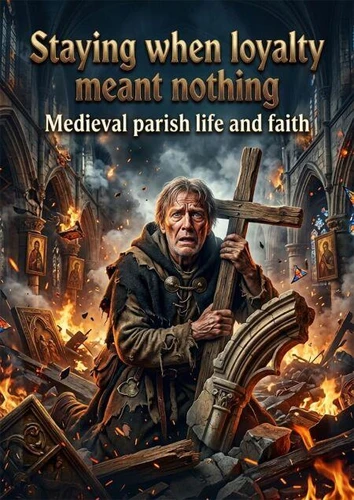
Staying when loyalty meant nothing. Medieval parish life and faith
Par :Formats :
Disponible dans votre compte client Decitre ou Furet du Nord dès validation de votre commande. Le format ePub est :
- Compatible avec une lecture sur My Vivlio (smartphone, tablette, ordinateur)
- Compatible avec une lecture sur liseuses Vivlio
- Pour les liseuses autres que Vivlio, vous devez utiliser le logiciel Adobe Digital Edition. Non compatible avec la lecture sur les liseuses Kindle, Remarkable et Sony
 , qui est-ce ?
Notre partenaire de plateforme de lecture numérique où vous retrouverez l'ensemble de vos ebooks gratuitement
Pour en savoir plus sur nos ebooks, consultez notre aide en ligne ici
C'est si simple ! Lisez votre ebook avec l'app Vivlio sur votre tablette, mobile ou ordinateur :

- Nombre de pages171
- FormatePub
- ISBN978-3-565-58693-6
- EAN9783565586936
- Date de parution25/07/2026
- Protection num.pas de protection
- Taille1 Mo
- Infos supplémentairesepub
- ÉditeurEmphaloz Publishing House
Résumé
The church was not a building. For the medieval villager, it was the rhythm that split the year into planting and fasting, the authority that sanctioned marriage and buried the dead, the unseen hand that reached into the cradle and the grave alike. This history examines how ecclesiastical power operated not through cathedrals and councils, but through the daily negotiations of ordinary people who tithed, confessed, and obeyed.
Drawing on manorial records, sermon collections, and penitential manuals, it reconstructs a world where salvation was a practical concern and sin had a price. The parish priest was often as poor as his flock; the bishop was a landlord; the monastery was an economic engine. Faith and survival intertwined in ways that shaped European society for centuries. What emerges is not a story of piety alone, but of a social system held together by shared belief and mutual dependence.
Drawing on manorial records, sermon collections, and penitential manuals, it reconstructs a world where salvation was a practical concern and sin had a price. The parish priest was often as poor as his flock; the bishop was a landlord; the monastery was an economic engine. Faith and survival intertwined in ways that shaped European society for centuries. What emerges is not a story of piety alone, but of a social system held together by shared belief and mutual dependence.
A propos de Claire Monroe











24,99 €


9,99 €