Writes reflective books on philosophy, discipline, and human behavior.
Nouveauté
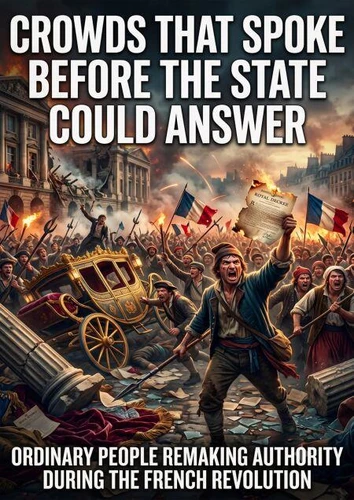
Crowds that spoke before the state could answer. Ordinary people remaking authority during the French Revolution
Par :Formats :
Disponible dans votre compte client Decitre ou Furet du Nord dès validation de votre commande. Le format ePub est :
- Compatible avec une lecture sur My Vivlio (smartphone, tablette, ordinateur)
- Compatible avec une lecture sur liseuses Vivlio
- Pour les liseuses autres que Vivlio, vous devez utiliser le logiciel Adobe Digital Edition. Non compatible avec la lecture sur les liseuses Kindle, Remarkable et Sony
 , qui est-ce ?
Notre partenaire de plateforme de lecture numérique où vous retrouverez l'ensemble de vos ebooks gratuitement
Pour en savoir plus sur nos ebooks, consultez notre aide en ligne ici
C'est si simple ! Lisez votre ebook avec l'app Vivlio sur votre tablette, mobile ou ordinateur :

- Nombre de pages227
- FormatePub
- ISBN978-3-565-55559-8
- EAN9783565555598
- Date de parution10/07/2026
- Protection num.pas de protection
- Taille1 Mo
- Infos supplémentairesepub
- ÉditeurEmphaloz Publishing House
Résumé
When a king calls a meeting he cannot control, the foundation of every throne trembles. France in 1789 did not begin with revolutionaries storming barricades but with a monarchy that lost the authority to govern itself. This book follows the unraveling of institutional power from Versailles to the streets of Paris, showing how the old regime collapsed less from attack than from its own internal fractures.
The Estates-General became a stage where centuries of hierarchy dissolved into open conflict between orders, and the Third Estate transformed itself from subjects into representatives of a sovereign nation. Each step-the Tennis Court Oath, the fall of the Bastille, the abolition of feudal privileges-revealed a system that could no longer justify its own existence. Power did not shift from king to people in a single stroke; it drained out of every institution that once held it, leaving a vacuum into which ideology, fear, and ambition rushed.
The revolution consumed those who made it, from Mirabeau to Robespierre, as the logic of popular sovereignty demanded purer and purer forms of loyalty. Across Europe, monarchs watched and learned nothing, believing the fire would not cross their borders. This book traces the mechanisms by which authority becomes legitimacy and then becomes terror, asking what happens when a society decides that everything must change at once.
The Estates-General became a stage where centuries of hierarchy dissolved into open conflict between orders, and the Third Estate transformed itself from subjects into representatives of a sovereign nation. Each step-the Tennis Court Oath, the fall of the Bastille, the abolition of feudal privileges-revealed a system that could no longer justify its own existence. Power did not shift from king to people in a single stroke; it drained out of every institution that once held it, leaving a vacuum into which ideology, fear, and ambition rushed.
The revolution consumed those who made it, from Mirabeau to Robespierre, as the logic of popular sovereignty demanded purer and purer forms of loyalty. Across Europe, monarchs watched and learned nothing, believing the fire would not cross their borders. This book traces the mechanisms by which authority becomes legitimacy and then becomes terror, asking what happens when a society decides that everything must change at once.
A propos de Claire Monroe








24,99 €


9,99 €