Writes reflective books on philosophy, discipline, and human behavior.
Nouveauté
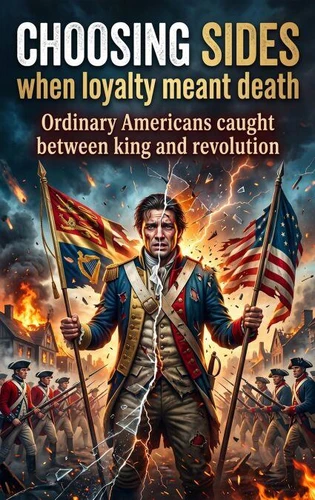
Choosing sides when loyalty meant death. Ordinary Americans caught between king and revolution
Par :Formats :
Disponible dans votre compte client Decitre ou Furet du Nord dès validation de votre commande. Le format ePub est :
- Compatible avec une lecture sur My Vivlio (smartphone, tablette, ordinateur)
- Compatible avec une lecture sur liseuses Vivlio
- Pour les liseuses autres que Vivlio, vous devez utiliser le logiciel Adobe Digital Edition. Non compatible avec la lecture sur les liseuses Kindle, Remarkable et Sony
 , qui est-ce ?
Notre partenaire de plateforme de lecture numérique où vous retrouverez l'ensemble de vos ebooks gratuitement
Pour en savoir plus sur nos ebooks, consultez notre aide en ligne ici
C'est si simple ! Lisez votre ebook avec l'app Vivlio sur votre tablette, mobile ou ordinateur :

- Nombre de pages223
- FormatePub
- ISBN978-3-565-54839-2
- EAN9783565548392
- Date de parution08/07/2026
- Protection num.pas de protection
- Taille2 Mo
- Infos supplémentairesepub
- ÉditeurEmphaloz Publishing House
Résumé
When the first shots were fired at Lexington, the question was not about independence-it was about whose authority a man would answer to. In the years that followed, American colonists did not simply choose sides between Britain and rebellion; they confronted a deeper fracture: what happens when law, family, and conscience no longer point in the same direction. This narrative follows six men-a Boston merchant loyal to the Crown, a Virginia planter who hesitated, a New York printer who changed his mind twice, a farmer who refused both armies, a British officer haunted by the men he hanged, and a Continental soldier who deserted and returned-to show that the American Revolution was not a clean break but a slow, violent reckoning with the meaning of allegiance itself.
Through their letters, court records, and diaries, the book traces how ordinary men became rebels or loyalists not out of ideology alone but because of debts, grudges, hopes, and fears that had nothing to do with taxation. The war ended in 1783, but the question of who had the right to command obedience did not. This is not a story of patriotic triumph. It is a story of men who had to decide what they owed, and to whom, when the world they knew was collapsing around them.
Through their letters, court records, and diaries, the book traces how ordinary men became rebels or loyalists not out of ideology alone but because of debts, grudges, hopes, and fears that had nothing to do with taxation. The war ended in 1783, but the question of who had the right to command obedience did not. This is not a story of patriotic triumph. It is a story of men who had to decide what they owed, and to whom, when the world they knew was collapsing around them.
A propos de Claire Monroe






24,99 €


9,99 €