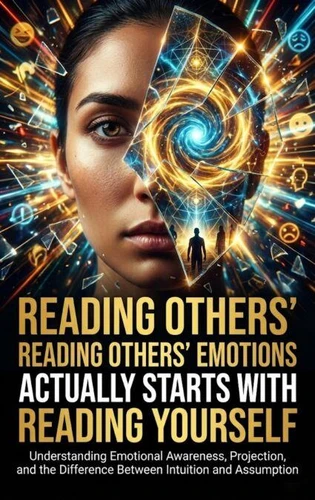
Reading Others' Emotions Actually Starts With Reading Yourself. Understanding Emotional Awareness, Projection, and the Difference Between Intuition and Assumption
Par :Formats :
Disponible dans votre compte client Decitre ou Furet du Nord dès validation de votre commande. Le format ePub est :
- Compatible avec une lecture sur My Vivlio (smartphone, tablette, ordinateur)
- Compatible avec une lecture sur liseuses Vivlio
- Pour les liseuses autres que Vivlio, vous devez utiliser le logiciel Adobe Digital Edition. Non compatible avec la lecture sur les liseuses Kindle, Remarkable et Sony
 , qui est-ce ?
Notre partenaire de plateforme de lecture numérique où vous retrouverez l'ensemble de vos ebooks gratuitement
Pour en savoir plus sur nos ebooks, consultez notre aide en ligne ici
C'est si simple ! Lisez votre ebook avec l'app Vivlio sur votre tablette, mobile ou ordinateur :

- Nombre de pages202
- FormatePub
- ISBN978-3-565-20829-6
- EAN9783565208296
- Date de parution29/01/2026
- Protection num.pas de protection
- Taille2 Mo
- Infos supplémentairesepub
- ÉditeurEmphaloz Publishing House
Résumé
This book explores the foundation of accurately perceiving others' emotions-examining how your capacity to read emotional cues depends first on recognizing and understanding your own internal states. It reframes emotional perception not as a skill of analyzing others, but as developing enough self-awareness to distinguish between what someone is actually communicating and what you're projecting based on your own patterns and fears.
Rather than offering techniques to decode body language or facial expressions, this book invites you to understand how your nervous system interprets emotional information through the lens of past experiences.
It explores the patterns beneath hypervigilance to others' moods, misreading neutral expressions as rejection, and the difference between genuine emotional attunement and anxious overinterpretation driven by your own insecurity. Through psychological insight into emotional intelligence, mirror neurons, and how trauma shapes perception, this book offers a compassionate path toward clearer understanding.
It examines why highly empathic people sometimes misread emotions more than they realize, how childhood roles like peacemaker or caretaker create specific perceptual biases, and why accurate emotional reading requires acknowledging the limits of what you can actually know. The goal isn't becoming a mind reader-it's developing enough internal clarity to perceive others more accurately while staying grounded in what they're actually showing you.
It explores the patterns beneath hypervigilance to others' moods, misreading neutral expressions as rejection, and the difference between genuine emotional attunement and anxious overinterpretation driven by your own insecurity. Through psychological insight into emotional intelligence, mirror neurons, and how trauma shapes perception, this book offers a compassionate path toward clearer understanding.
It examines why highly empathic people sometimes misread emotions more than they realize, how childhood roles like peacemaker or caretaker create specific perceptual biases, and why accurate emotional reading requires acknowledging the limits of what you can actually know. The goal isn't becoming a mind reader-it's developing enough internal clarity to perceive others more accurately while staying grounded in what they're actually showing you.
A propos de Alina Frost

















8,99 €