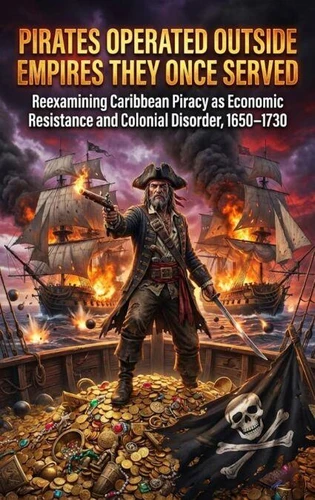
Pirates Operated Outside Empires They Once Served. Reexamining Caribbean Piracy as Economic Resistance and Colonial Disorder, 1650–1730
Par :Formats :
Disponible dans votre compte client Decitre ou Furet du Nord dès validation de votre commande. Le format ePub est :
- Compatible avec une lecture sur My Vivlio (smartphone, tablette, ordinateur)
- Compatible avec une lecture sur liseuses Vivlio
- Pour les liseuses autres que Vivlio, vous devez utiliser le logiciel Adobe Digital Edition. Non compatible avec la lecture sur les liseuses Kindle, Remarkable et Sony
 , qui est-ce ?
Notre partenaire de plateforme de lecture numérique où vous retrouverez l'ensemble de vos ebooks gratuitement
Pour en savoir plus sur nos ebooks, consultez notre aide en ligne ici
C'est si simple ! Lisez votre ebook avec l'app Vivlio sur votre tablette, mobile ou ordinateur :

- Nombre de pages183
- FormatePub
- ISBN978-3-565-21075-6
- EAN9783565210756
- Date de parution30/01/2026
- Protection num.pas de protection
- Taille2 Mo
- Infos supplémentairesepub
- ÉditeurEmphaloz Publishing House
Résumé
The Golden Age of Piracy wasn't simply lawless adventure-it emerged from the fractures of imperial expansion, where sailors, escaped slaves, and dispossessed colonists created autonomous communities beyond European control. This book traces how Caribbean piracy developed as both economic survival strategy and rejection of the brutal hierarchies governing colonial trade, naval service, and plantation labor.
Through admiralty court records, ship logs, colonial correspondence, and rare pirate testimonies, the narrative reveals who became pirates and why: merchant sailors facing starvation wages and deadly conditions, privateers abandoned when wars ended, Africans who escaped enslavement, indigenous peoples resisting colonization.
Pirate crews established surprisingly democratic governance-elected captains, shared plunder, disability compensation-that contrasted sharply with the absolute authority on naval and merchant vessels. The book examines piracy's relationship to legitimate commerce: how pirates disrupted Spanish silver flows, challenged English and French trade monopolies, and forced colonial powers to negotiate despite official rhetoric of extermination.
It follows the establishment of pirate havens like Nassau, where multi-ethnic communities temporarily flourished outside plantation economies and racial hierarchies, until imperial navies systematically destroyed these alternatives. Crucially, the narrative avoids romanticization while taking pirates seriously as historical actors who exploited and perpetuated violence even as they resisted exploitation themselves.
Their suppression reveals how European powers consolidated control over Atlantic trade through coordinated naval force, expanded legal frameworks, and elimination of economic alternatives to imperial systems.
Pirate crews established surprisingly democratic governance-elected captains, shared plunder, disability compensation-that contrasted sharply with the absolute authority on naval and merchant vessels. The book examines piracy's relationship to legitimate commerce: how pirates disrupted Spanish silver flows, challenged English and French trade monopolies, and forced colonial powers to negotiate despite official rhetoric of extermination.
It follows the establishment of pirate havens like Nassau, where multi-ethnic communities temporarily flourished outside plantation economies and racial hierarchies, until imperial navies systematically destroyed these alternatives. Crucially, the narrative avoids romanticization while taking pirates seriously as historical actors who exploited and perpetuated violence even as they resisted exploitation themselves.
Their suppression reveals how European powers consolidated control over Atlantic trade through coordinated naval force, expanded legal frameworks, and elimination of economic alternatives to imperial systems.
A propos de Alina Frost


















8,99 €