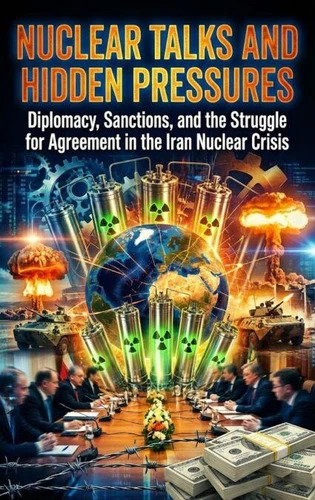
Nuclear Talks and Hidden Pressures. Diplomacy, Sanctions, and the Struggle for Agreement in the Iran Nuclear Crisis
Par :Formats :
Disponible dans votre compte client Decitre ou Furet du Nord dès validation de votre commande. Le format ePub est :
- Compatible avec une lecture sur My Vivlio (smartphone, tablette, ordinateur)
- Compatible avec une lecture sur liseuses Vivlio
- Pour les liseuses autres que Vivlio, vous devez utiliser le logiciel Adobe Digital Edition. Non compatible avec la lecture sur les liseuses Kindle, Remarkable et Sony
 , qui est-ce ?
Notre partenaire de plateforme de lecture numérique où vous retrouverez l'ensemble de vos ebooks gratuitement
Pour en savoir plus sur nos ebooks, consultez notre aide en ligne ici
C'est si simple ! Lisez votre ebook avec l'app Vivlio sur votre tablette, mobile ou ordinateur :

- Nombre de pages175
- FormatePub
- ISBN978-3-565-27243-3
- EAN9783565272433
- Date de parution25/02/2026
- Protection num.pas de protection
- Taille2 Mo
- Infos supplémentairesepub
- ÉditeurEmphaloz Publishing House
Résumé
The negotiations over Iran's nuclear program stand among the most complex diplomatic undertakings of the twenty-first century - conducted simultaneously at the table and through back channels, shaped as much by domestic political pressures in Washington, Tehran, and Brussels as by the technical details of uranium enrichment and inspection regimes.
This book reconstructs the full arc of nuclear diplomacy between Iran and the West, from the initial European-led talks of the early 2000s through the tortuous path to the 2015 Joint Comprehensive Plan of Action and its subsequent collapse under the weight of competing political interests.
Drawing on declassified diplomatic cables, memoirs of lead negotiators, and investigative reporting from multiple national perspectives, it examines the hidden pressures - domestic hardliners, regional rivals, corporate sanctions lobbies, and intelligence operations - that shaped every stage of the negotiating process. The account moves beyond the public record to reveal how agreements were constructed, undermined, and reconstructed under conditions of profound mutual distrust.
It asks not whether diplomacy succeeded or failed, but what the process itself reveals about the structural constraints on international negotiation when existential interests, historical grievance, and geopolitical rivalry converge at the same table. For readers seeking a rigorous, evidence-based account of one of modern history's most consequential diplomatic episodes, this book offers clarity where political rhetoric has long produced only noise.
Drawing on declassified diplomatic cables, memoirs of lead negotiators, and investigative reporting from multiple national perspectives, it examines the hidden pressures - domestic hardliners, regional rivals, corporate sanctions lobbies, and intelligence operations - that shaped every stage of the negotiating process. The account moves beyond the public record to reveal how agreements were constructed, undermined, and reconstructed under conditions of profound mutual distrust.
It asks not whether diplomacy succeeded or failed, but what the process itself reveals about the structural constraints on international negotiation when existential interests, historical grievance, and geopolitical rivalry converge at the same table. For readers seeking a rigorous, evidence-based account of one of modern history's most consequential diplomatic episodes, this book offers clarity where political rhetoric has long produced only noise.
A propos de Alina Frost

















8,99 €