SOLDES
Jusqu'à -70% sur une sélection d'articles*

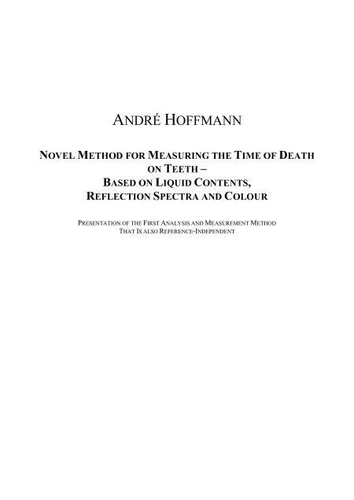
Novel Method for Measuring the Time of Death on Teeth - Based on Liquid Contents, Reflection Spectra and Colour. Presentation of the First Analysis and Measurement Method That Is also Reference-Independent
Par :Formats :
Disponible dans votre compte client Decitre ou Furet du Nord dès validation de votre commande. Le format PDF est :
- Compatible avec une lecture sur My Vivlio (smartphone, tablette, ordinateur)
- Compatible avec une lecture sur liseuses Vivlio
- Pour les liseuses autres que Vivlio, vous devez utiliser le logiciel Adobe Digital Edition. Non compatible avec la lecture sur les liseuses Kindle, Remarkable et Sony
 , qui est-ce ?
Notre partenaire de plateforme de lecture numérique où vous retrouverez l'ensemble de vos ebooks gratuitement
Pour en savoir plus sur nos ebooks, consultez notre aide en ligne ici
C'est si simple ! Lisez votre ebook avec l'app Vivlio sur votre tablette, mobile ou ordinateur :

- Nombre de pages96
- FormatPDF
- ISBN3-340-00038-7
- EAN9783340000381
- Date de parution25/05/2004
- Protection num.Digital Watermarking
- Taille48 Mo
- Infos supplémentairespdf
- ÉditeurHoffmann
Résumé
Knowing about the time of death is often the central key to solving criminal cases. The time of death is also relevant in cases of natural death - for the family register entry, for the insurance system or the succession. However, the forensic medical estimation of the time of death (postmortal interval) is still not without limitations - especially if it should be precise or if it cannot be done relatively immediately after onset of death.
With the onset of death, various processes begin to set in place that change a corpse and its tissues over the time axis. If it were possible to find a process in a certain tissue that would behave precisely like one or, better, several clockworks, and if it were still possible to reset the time to the state before or at the time of death, if it would also be possible that these synchronous clocks run again, and if it were also possible to run the elapsed time after death in real time on the identical individual to be examined or the identical examination object under comparable conditions (simulation), the perfect and most precise method for determining the time of death would be born. The author of the present work has observed that teeth of dead appear much brighter, differently coloured and less translucent and more opaque than teeth of living people and that dental colour changes are based on reversible drying and liquid absorption processes and can be measured with high precision and very differentiated values - he revealed phenomena, paradoxes, dynamics and liquid flow and articulates the "dental fingerprint" for identification, "tooth clock", "tooth memory" ... He measures the loss of liquid in ranges of up to one millionth of a gram, in the microgram range, as well as the colour and reflection spectra with high-precision measuring systems and he sees a fundamental possibility in the use of processes that he has measured and analyzed on drying and liquid-absorbing teeth and he is presenting a novel method for the first time.
Furthermore, for the first time, he also presents a reference-independent approach (perhaps the first reference-independent analysis or measurement method in the natural sciences) based on drying up to the time of the first measurement, liquid storage and repeated drying - the actual simulation. For this reference-independent method approach, in contrast to his reference-dependent method, it does not necessarily need reference values, i.e.
values that had to be obtained beforehand on other, comparable samples (see nomogram), but only values that were obtained previously on the identical object. For the first time, the "scattering problem" was circumvented - the way to a high-precision method? The novel method of analyzing and measuring the time of death seems to have a number of advantages: objectifying measurement instead of subjective estimations of stages; several independent values, such as L *, a *, b *, C *, h, M, spectral values, instead of just one numerical value (temperature in degrees) in the case of the body cooling method, reversibility instead of irreversibility of the processes and thus, after sufficient liquid storage, repeatability of the post-mortem conditions and consequently the post-mortem interval up to the first measurement in the context of a simulation under comparable conditions on the identical object and thus avoidance of the "scattering problem", avoidance of intra- and inter-individual differences on both sides of the autopsy table - for the estimating and for the estimated individual, time of death measurement on site or high-precision measurements with high-precision positioning systems instead of measurement with thermometers, in the author's vision, comfortable measurements of various samples independently of one another within an automatic analyzer simulating ambient conditions in the laboratory instead .
- A breakthrough?
With the onset of death, various processes begin to set in place that change a corpse and its tissues over the time axis. If it were possible to find a process in a certain tissue that would behave precisely like one or, better, several clockworks, and if it were still possible to reset the time to the state before or at the time of death, if it would also be possible that these synchronous clocks run again, and if it were also possible to run the elapsed time after death in real time on the identical individual to be examined or the identical examination object under comparable conditions (simulation), the perfect and most precise method for determining the time of death would be born. The author of the present work has observed that teeth of dead appear much brighter, differently coloured and less translucent and more opaque than teeth of living people and that dental colour changes are based on reversible drying and liquid absorption processes and can be measured with high precision and very differentiated values - he revealed phenomena, paradoxes, dynamics and liquid flow and articulates the "dental fingerprint" for identification, "tooth clock", "tooth memory" ... He measures the loss of liquid in ranges of up to one millionth of a gram, in the microgram range, as well as the colour and reflection spectra with high-precision measuring systems and he sees a fundamental possibility in the use of processes that he has measured and analyzed on drying and liquid-absorbing teeth and he is presenting a novel method for the first time.
Furthermore, for the first time, he also presents a reference-independent approach (perhaps the first reference-independent analysis or measurement method in the natural sciences) based on drying up to the time of the first measurement, liquid storage and repeated drying - the actual simulation. For this reference-independent method approach, in contrast to his reference-dependent method, it does not necessarily need reference values, i.e.
values that had to be obtained beforehand on other, comparable samples (see nomogram), but only values that were obtained previously on the identical object. For the first time, the "scattering problem" was circumvented - the way to a high-precision method? The novel method of analyzing and measuring the time of death seems to have a number of advantages: objectifying measurement instead of subjective estimations of stages; several independent values, such as L *, a *, b *, C *, h, M, spectral values, instead of just one numerical value (temperature in degrees) in the case of the body cooling method, reversibility instead of irreversibility of the processes and thus, after sufficient liquid storage, repeatability of the post-mortem conditions and consequently the post-mortem interval up to the first measurement in the context of a simulation under comparable conditions on the identical object and thus avoidance of the "scattering problem", avoidance of intra- and inter-individual differences on both sides of the autopsy table - for the estimating and for the estimated individual, time of death measurement on site or high-precision measurements with high-precision positioning systems instead of measurement with thermometers, in the author's vision, comfortable measurements of various samples independently of one another within an automatic analyzer simulating ambient conditions in the laboratory instead .
- A breakthrough?
A propos de André Hoffmann


1,49 €

1,49 €

Die Leute von Seldwyla
E-book
1,99 €


Clavigo. Ein Trauerspiel
E-book
1,99 €

Der Nachsommer
E-book
1,99 €

1,99 €

1,99 €

Traumnovelle
E-book
1,99 €

1,49 €
1,99 €


Dichtungen
E-book
1,99 €

Einbahnstraße
E-book
1,49 €

1,99 €

1,99 €

Die Hochzeit des Mönchs
E-book
1,49 €

1,99 €

Angela Borgia
E-book
1,49 €