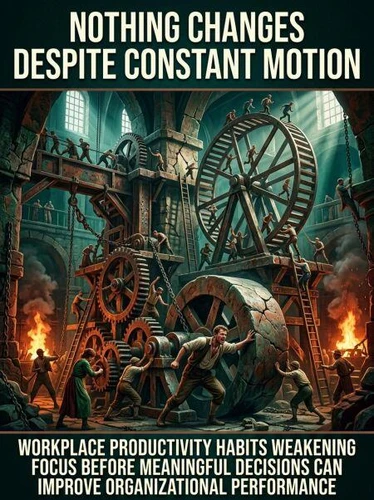
Nothing Changes Despite Constant Motion. Workplace productivity habits weakening focus before meaningful decisions can improve organizational performance
Par :Formats :
Disponible dans votre compte client Decitre ou Furet du Nord dès validation de votre commande. Le format ePub est :
- Compatible avec une lecture sur My Vivlio (smartphone, tablette, ordinateur)
- Compatible avec une lecture sur liseuses Vivlio
- Pour les liseuses autres que Vivlio, vous devez utiliser le logiciel Adobe Digital Edition. Non compatible avec la lecture sur les liseuses Kindle, Remarkable et Sony
 , qui est-ce ?
Notre partenaire de plateforme de lecture numérique où vous retrouverez l'ensemble de vos ebooks gratuitement
Pour en savoir plus sur nos ebooks, consultez notre aide en ligne ici
C'est si simple ! Lisez votre ebook avec l'app Vivlio sur votre tablette, mobile ou ordinateur :

- Nombre de pages131
- FormatePub
- ISBN978-3-565-48279-5
- EAN9783565482795
- Date de parution07/06/2026
- Protection num.pas de protection
- Taille1 Mo
- Infos supplémentairesepub
- ÉditeurEmphaloz Publishing House
Résumé
Workplace productivity has become increasingly difficult to measure inside modern organizations. Employees answer messages faster, attend more meetings, and manage larger communication flows than ever before. Yet many professionals quietly experience exhaustion without feeling genuinely effective. Burnout often begins where visible activity replaces meaningful contribution.
This book explores how corporate systems unintentionally reward motion over value creation.
Teams remain permanently occupied while strategic priorities become harder to execute. Employees shift between tasks continuously but rarely sustain enough concentration to produce high-quality outcomes. Using practical organizational frameworks, the book examines how fragmented attention weakens decision-making, why operational overload damages motivation, and how excessive coordination creates hidden productivity loss.
It also analyzes how workplace culture reinforces performative busyness through responsiveness expectations, overloaded calendars, and constant accessibility. Rather than promoting extreme efficiency or personal optimization trends, the book focuses on sustainable effectiveness. It explains how professionals can reconnect effort with measurable contribution while protecting cognitive energy inside demanding environments. For European companies facing rising mental fatigue, demographic pressure, and increasing organizational complexity, effectiveness is becoming a structural advantage rather than an individual trait.
Long-term resilience depends not only on performance targets, but on whether employees still experience their work as valuable and psychologically sustainable.
Teams remain permanently occupied while strategic priorities become harder to execute. Employees shift between tasks continuously but rarely sustain enough concentration to produce high-quality outcomes. Using practical organizational frameworks, the book examines how fragmented attention weakens decision-making, why operational overload damages motivation, and how excessive coordination creates hidden productivity loss.
It also analyzes how workplace culture reinforces performative busyness through responsiveness expectations, overloaded calendars, and constant accessibility. Rather than promoting extreme efficiency or personal optimization trends, the book focuses on sustainable effectiveness. It explains how professionals can reconnect effort with measurable contribution while protecting cognitive energy inside demanding environments. For European companies facing rising mental fatigue, demographic pressure, and increasing organizational complexity, effectiveness is becoming a structural advantage rather than an individual trait.
Long-term resilience depends not only on performance targets, but on whether employees still experience their work as valuable and psychologically sustainable.