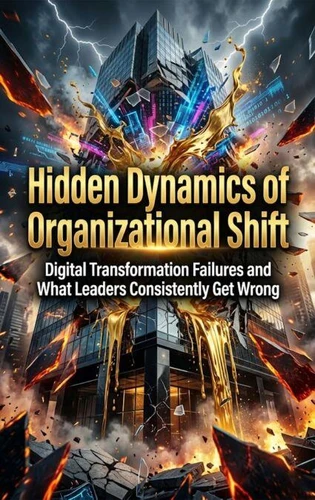
Hidden Dynamics of Organizational Shift. Digital Transformation Failures and What Leaders Consistently Get Wrong
Par :Formats :
Disponible dans votre compte client Decitre ou Furet du Nord dès validation de votre commande. Le format ePub est :
- Compatible avec une lecture sur My Vivlio (smartphone, tablette, ordinateur)
- Compatible avec une lecture sur liseuses Vivlio
- Pour les liseuses autres que Vivlio, vous devez utiliser le logiciel Adobe Digital Edition. Non compatible avec la lecture sur les liseuses Kindle, Remarkable et Sony
 , qui est-ce ?
Notre partenaire de plateforme de lecture numérique où vous retrouverez l'ensemble de vos ebooks gratuitement
Pour en savoir plus sur nos ebooks, consultez notre aide en ligne ici
C'est si simple ! Lisez votre ebook avec l'app Vivlio sur votre tablette, mobile ou ordinateur :

- Nombre de pages156
- FormatePub
- ISBN978-3-565-45401-3
- EAN9783565454013
- Date de parution22/05/2026
- Protection num.pas de protection
- Taille2 Mo
- Infos supplémentairesepub
- ÉditeurEmphaloz Publishing House
Résumé
This book investigates how hidden organizational dynamics emerge when digital transformation efforts fail because critical leadership missteps go unnoticed. It explores the tension between visible change initiatives and the less visible systems, including decision-making hierarchies, information flows, and incentive structures, that quietly shape organizational outcomes. At its core, the analysis asks why leaders so often overlook the warning signs that eventually lead transformation projects toward failure.
The first focus is on decision-making hierarchies and how layers of approval can suppress early warning signals from frontline teams, reinforcing consensus thinking and delaying corrective action.
The second examines patterns of information flow, showing how siloed departments and fragmented communication can create blind spots that prevent emerging risks from becoming visible until problems escalate. The third investigates incentive structures that reward short-term metrics and milestone completion over long-term adaptation, encouraging leaders to prioritize measurable outputs while neglecting the deeper organizational shifts that determine whether transformation efforts truly succeed.
Together, these mechanisms reveal how digital transformation is often undermined not by technology itself, but by the invisible organizational forces that distort perception, weaken alignment, and obscure the roots of failure.
The second examines patterns of information flow, showing how siloed departments and fragmented communication can create blind spots that prevent emerging risks from becoming visible until problems escalate. The third investigates incentive structures that reward short-term metrics and milestone completion over long-term adaptation, encouraging leaders to prioritize measurable outputs while neglecting the deeper organizational shifts that determine whether transformation efforts truly succeed.
Together, these mechanisms reveal how digital transformation is often undermined not by technology itself, but by the invisible organizational forces that distort perception, weaken alignment, and obscure the roots of failure.