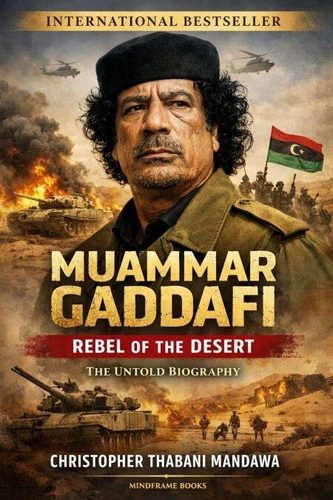
Muammar Gaddafi was one of the most enigmatic and polarizing figures of the modern era. To some he was a fearless revolutionary who reclaimed Libya's dignity, challenged Western dominance, and redistributed the nation's oil wealth to its people. To others he was an unpredictable autocrat whose rule was marked by repression, conflict, and spectacle. Few leaders inspired such intense devotion and such fierce condemnation, and fewer still reshaped their country so completely in their own image.
This book traces the extraordinary journey of Gaddafi from a barefoot Bedouin boy of the Libyan desert to the most powerful man in North Africa. It explores how his early experiences under monarchy and foreign influence forged a radical vision of justice, sovereignty, and popular rule. Through revolution, ideology, and absolute power, Gaddafi attempted to construct a political system unlike any the world had seen, rejecting both capitalism and communism in favor of his own revolutionary doctrine.
Rebel of the Desert does not seek to sanctify or demonize its subject. Instead, it offers a balanced and human portrait of a leader driven by conviction, contradiction, and ambition. By examining his rise, his rule, and his violent fall, this book asks a larger question: how does a man who claims to speak for the people become indistinguishable from the state itself? In answering that question, Gaddafi's story becomes a cautionary tale about power, idealism, and the fragile line between liberation and domination.
Muammar Gaddafi was one of the most enigmatic and polarizing figures of the modern era. To some he was a fearless revolutionary who reclaimed Libya's dignity, challenged Western dominance, and redistributed the nation's oil wealth to its people. To others he was an unpredictable autocrat whose rule was marked by repression, conflict, and spectacle. Few leaders inspired such intense devotion and such fierce condemnation, and fewer still reshaped their country so completely in their own image.
This book traces the extraordinary journey of Gaddafi from a barefoot Bedouin boy of the Libyan desert to the most powerful man in North Africa. It explores how his early experiences under monarchy and foreign influence forged a radical vision of justice, sovereignty, and popular rule. Through revolution, ideology, and absolute power, Gaddafi attempted to construct a political system unlike any the world had seen, rejecting both capitalism and communism in favor of his own revolutionary doctrine.
Rebel of the Desert does not seek to sanctify or demonize its subject. Instead, it offers a balanced and human portrait of a leader driven by conviction, contradiction, and ambition. By examining his rise, his rule, and his violent fall, this book asks a larger question: how does a man who claims to speak for the people become indistinguishable from the state itself? In answering that question, Gaddafi's story becomes a cautionary tale about power, idealism, and the fragile line between liberation and domination.


 , qui est-ce ?