Jared Douglas is an English-language nonfiction author known for writing investigative works on economics, industrial systems, and the hidden infrastructure behind modern society. His books combine analytical depth with accessible storytelling, examining how supply chains, corporate influence, technological change, and political decisions shape everyday life in ways most people rarely notice. Jared's writing style is direct, immersive, and richly detailed, turning complex institutional subjects into narratives that feel both urgent and deeply human.
Nouveauté
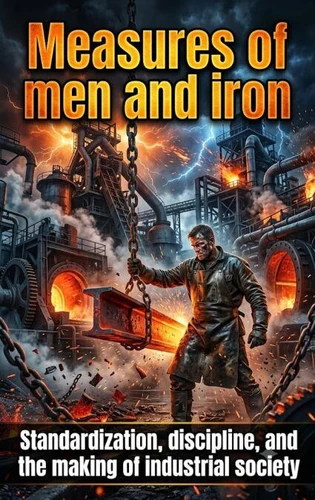
Measures of men and iron. Standardization, discipline, and the making of industrial society
Par :Formats :
Disponible dans votre compte client Decitre ou Furet du Nord dès validation de votre commande. Le format ePub est :
- Compatible avec une lecture sur My Vivlio (smartphone, tablette, ordinateur)
- Compatible avec une lecture sur liseuses Vivlio
- Pour les liseuses autres que Vivlio, vous devez utiliser le logiciel Adobe Digital Edition. Non compatible avec la lecture sur les liseuses Kindle, Remarkable et Sony
 , qui est-ce ?
Notre partenaire de plateforme de lecture numérique où vous retrouverez l'ensemble de vos ebooks gratuitement
Pour en savoir plus sur nos ebooks, consultez notre aide en ligne ici
C'est si simple ! Lisez votre ebook avec l'app Vivlio sur votre tablette, mobile ou ordinateur :

- Nombre de pages198
- FormatePub
- ISBN978-3-565-54792-0
- EAN9783565547920
- Date de parution08/07/2026
- Protection num.pas de protection
- Taille654 Ko
- Infos supplémentairesepub
- ÉditeurEmphaloz Publishing House
Résumé
Before the factory whistle, time was local and variable. After it, the clock ruled. This book examines the Industrial Revolution as a project of standardization: of time, of work, of materials, of human behavior. Railways required synchronized schedules. Mass production required interchangeable parts. Armies required uniform training. The industrial system did not merely produce goods. It produced a new kind of person: punctual, disciplined, responsive to abstract incentives.
The book traces how institutions-factories, schools, prisons, barracks-adopted similar techniques of organization and surveillance. It examines the role of engineers, managers, and state officials in designing systems that maximized output and minimized variance. It also considers resistance: Luddites breaking machines, craftsmen defending tacit knowledge, communities rejecting the factory model. The transformation was not inevitable.
It was designed, imposed, and contested. The book draws on archives from Britain, Germany, and the United States to show how industrial logic spread beyond the factory floor into education, medicine, and domestic life. What emerged was not just an economy but a civilization organized around measurement, efficiency, and control. The question the book leaves open: what else was standardized out of existence?
The book traces how institutions-factories, schools, prisons, barracks-adopted similar techniques of organization and surveillance. It examines the role of engineers, managers, and state officials in designing systems that maximized output and minimized variance. It also considers resistance: Luddites breaking machines, craftsmen defending tacit knowledge, communities rejecting the factory model. The transformation was not inevitable.
It was designed, imposed, and contested. The book draws on archives from Britain, Germany, and the United States to show how industrial logic spread beyond the factory floor into education, medicine, and domestic life. What emerged was not just an economy but a civilization organized around measurement, efficiency, and control. The question the book leaves open: what else was standardized out of existence?