
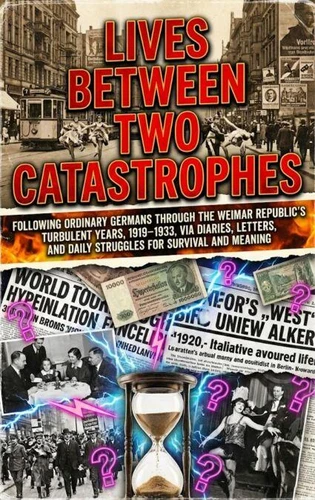
Lives Between Two Catastrophes. Following Ordinary Germans Through the Weimar Republic's Turbulent Years, 1919–1933, Via Diaries, Letters, and Daily Struggles for Survival and Meaning
Par :Formats :
Disponible dans votre compte client Decitre ou Furet du Nord dès validation de votre commande. Le format ePub est :
- Compatible avec une lecture sur My Vivlio (smartphone, tablette, ordinateur)
- Compatible avec une lecture sur liseuses Vivlio
- Pour les liseuses autres que Vivlio, vous devez utiliser le logiciel Adobe Digital Edition. Non compatible avec la lecture sur les liseuses Kindle, Remarkable et Sony
 , qui est-ce ?
Notre partenaire de plateforme de lecture numérique où vous retrouverez l'ensemble de vos ebooks gratuitement
Pour en savoir plus sur nos ebooks, consultez notre aide en ligne ici
C'est si simple ! Lisez votre ebook avec l'app Vivlio sur votre tablette, mobile ou ordinateur :

- Nombre de pages188
- FormatePub
- ISBN978-3-565-19890-0
- EAN9783565198900
- Date de parution27/01/2026
- Protection num.pas de protection
- Taille2 Mo
- Infos supplémentairesepub
- ÉditeurEmphaloz Publishing House
Résumé
The Weimar Republic unfolded not in grand political pronouncements alone, but in the lived experiences of people navigating impossible choices: a factory worker deciding whether to join a strike amid inflation that devoured wages overnight, a Jewish shopkeeper watching former neighbors embrace antisemitic rhetoric, a cabaret performer balancing artistic freedom against rising censorship demands, a war veteran unable to reconcile military defeat with civilian accusations of betrayal.
This book reconstructs the Republic through personal testimonies that reveal how political chaos translated into daily uncertainty.
It follows a middle-class family watching their savings evaporate during hyperinflation, forced to sell possessions for bread while politicians debated reparations. It traces a single mother's navigation of new social welfare programs while facing judgment from traditional communities. It examines a university student's radicalization as economic prospects collapsed and extremist movements offered belonging and purpose.
It explores an artist's conflicting impulses toward experimentation and commercial survival in Berlin's explosive cultural scene. Drawing on personal diaries, private correspondence, oral histories, memoirs written decades later, and photographic documentation of everyday moments, it captures the Republic's contradictions: unprecedented creative freedom alongside political violence, progressive social reforms alongside economic devastation, cosmopolitan urban culture alongside rural resentment, hope for democratic renewal alongside cynicism about institutional failure.
It reveals how ordinary people made sense of dizzying change, formed political allegiances, maintained dignity amid humiliation, and witnessed their society's disintegration. This is not a story of inevitable descent into dictatorship, but of individuals confronting choices whose consequences they could not fully grasp.
It follows a middle-class family watching their savings evaporate during hyperinflation, forced to sell possessions for bread while politicians debated reparations. It traces a single mother's navigation of new social welfare programs while facing judgment from traditional communities. It examines a university student's radicalization as economic prospects collapsed and extremist movements offered belonging and purpose.
It explores an artist's conflicting impulses toward experimentation and commercial survival in Berlin's explosive cultural scene. Drawing on personal diaries, private correspondence, oral histories, memoirs written decades later, and photographic documentation of everyday moments, it captures the Republic's contradictions: unprecedented creative freedom alongside political violence, progressive social reforms alongside economic devastation, cosmopolitan urban culture alongside rural resentment, hope for democratic renewal alongside cynicism about institutional failure.
It reveals how ordinary people made sense of dizzying change, formed political allegiances, maintained dignity amid humiliation, and witnessed their society's disintegration. This is not a story of inevitable descent into dictatorship, but of individuals confronting choices whose consequences they could not fully grasp.
A propos de Sarah Whitfield













8,99 €