SOLDES
Jusqu'à -70% sur une sélection d'articles*

Nouveauté
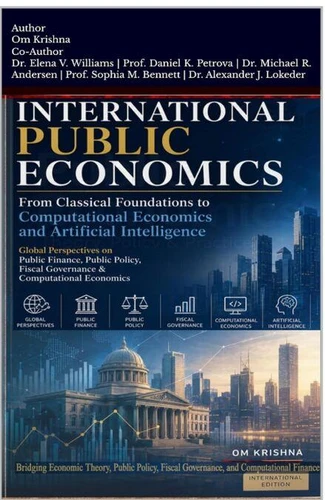
International Public Economics: From Classical Foundations to Computational Economics and Artificial Intelligence. 1, #1
Par :Formats :
Disponible dans votre compte client Decitre ou Furet du Nord dès validation de votre commande. Le format ePub est :
- Compatible avec une lecture sur My Vivlio (smartphone, tablette, ordinateur)
- Compatible avec une lecture sur liseuses Vivlio
- Pour les liseuses autres que Vivlio, vous devez utiliser le logiciel Adobe Digital Edition. Non compatible avec la lecture sur les liseuses Kindle, Remarkable et Sony
 , qui est-ce ?
Notre partenaire de plateforme de lecture numérique où vous retrouverez l'ensemble de vos ebooks gratuitement
Pour en savoir plus sur nos ebooks, consultez notre aide en ligne ici
C'est si simple ! Lisez votre ebook avec l'app Vivlio sur votre tablette, mobile ou ordinateur :

- FormatePub
- ISBN8235545533
- EAN9798235545533
- Date de parution30/06/2026
- Protection num.pas de protection
- Infos supplémentairesepub
- ÉditeurIoakim Ioakim
Résumé
What's New in This EditionInternational Public Economics: From Classical Foundations to Computational Economics and Artificial Intelligence is a comprehensive, research-oriented, and globally focused textbook that examines the evolution, theory, practice, and future of public economics in the twenty-first century. Bridging classical economic thought with the rapidly emerging fields of computational economics, digital governance, artificial intelligence, and data-driven public policy, the book provides an integrated framework for understanding the changing role of governments in increasingly complex economic systems.
Expanded coverage of Digital Public Economics, including Digital Government, Digital Public Finance, Digital Public Infrastructure (DPI), and digital governance. Entirely new section on Computational Public Economics, covering computational economics, econometrics, big data analytics, machine learning, and agent-based policy simulation. Comprehensive integration of artificial intelligence (AI) in public administration, fiscal governance, taxation, budgeting, and evidence-based policymaking.
Updated discussion on international taxation, including the OECD Global Minimum Tax, digital taxation, base erosion and profit shifting, and global tax governance. New chapters on climate finance, carbon pricing, emission trading systems, and green fiscal policy are aligned with sustainable development goals. Twelve new international case studies, including COVID-19 fiscal responses, Estonia's digital government, Singapore's smart nation, the European Union carbon market, global minimum corporate tax, universal healthcare systems, India's digital public infrastructure (UPI), Greece's and Argentina's sovereign debt crises, Climate Finance and Green Bonds, comparative fiscal federalism, and AI applications in government.
Recognizing the profound impact of globalization and technological transformation, the book explores international taxation, OECD tax reforms, digital taxation, climate finance, carbon pricing, environmental public economics, and global fiscal governance. Dedicated sections examine education and health economics, social security systems, poverty, inequality, and redistributive policies, highlighting their importance in achieving inclusive and sustainable development.
A distinctive contribution of this volume is its integration of digital public economics and computational public economics. Readers are introduced to digital government, digital public finance, digital public infrastructure, blockchain technology, financial technology (FinTech), artificial intelligence in public administration, econometric methods, big data analytics, machine learning, computational policy simulation, and agent-based modeling.
These emerging approaches demonstrate how advanced analytical tools are reshaping fiscal governance, policy evaluation, and evidence-based public decision-making across the world. Designed for advanced undergraduate and postgraduate students, doctoral researchers, civil service aspirants, policymakers, public administrators, economists, and academic professionals, this book combines rigorous theoretical analysis with empirical evidence, international comparisons, and modern computational approaches.
It serves as a definitive reference for understanding the evolution of public economics from its classical foundations to the emerging era of intelligent, data-driven, and digitally enabled governance, while addressing the fiscal, institutional, environmental, and technological challenges shaping public policy in the twenty-first century. Research-oriented approach Suitable for advanced undergraduate and postgraduate students, researchers, policymakers, public administrators, economists, and civil service aspirants.
Expanded coverage of Digital Public Economics, including Digital Government, Digital Public Finance, Digital Public Infrastructure (DPI), and digital governance. Entirely new section on Computational Public Economics, covering computational economics, econometrics, big data analytics, machine learning, and agent-based policy simulation. Comprehensive integration of artificial intelligence (AI) in public administration, fiscal governance, taxation, budgeting, and evidence-based policymaking.
Updated discussion on international taxation, including the OECD Global Minimum Tax, digital taxation, base erosion and profit shifting, and global tax governance. New chapters on climate finance, carbon pricing, emission trading systems, and green fiscal policy are aligned with sustainable development goals. Twelve new international case studies, including COVID-19 fiscal responses, Estonia's digital government, Singapore's smart nation, the European Union carbon market, global minimum corporate tax, universal healthcare systems, India's digital public infrastructure (UPI), Greece's and Argentina's sovereign debt crises, Climate Finance and Green Bonds, comparative fiscal federalism, and AI applications in government.
Recognizing the profound impact of globalization and technological transformation, the book explores international taxation, OECD tax reforms, digital taxation, climate finance, carbon pricing, environmental public economics, and global fiscal governance. Dedicated sections examine education and health economics, social security systems, poverty, inequality, and redistributive policies, highlighting their importance in achieving inclusive and sustainable development.
A distinctive contribution of this volume is its integration of digital public economics and computational public economics. Readers are introduced to digital government, digital public finance, digital public infrastructure, blockchain technology, financial technology (FinTech), artificial intelligence in public administration, econometric methods, big data analytics, machine learning, computational policy simulation, and agent-based modeling.
These emerging approaches demonstrate how advanced analytical tools are reshaping fiscal governance, policy evaluation, and evidence-based public decision-making across the world. Designed for advanced undergraduate and postgraduate students, doctoral researchers, civil service aspirants, policymakers, public administrators, economists, and academic professionals, this book combines rigorous theoretical analysis with empirical evidence, international comparisons, and modern computational approaches.
It serves as a definitive reference for understanding the evolution of public economics from its classical foundations to the emerging era of intelligent, data-driven, and digitally enabled governance, while addressing the fiscal, institutional, environmental, and technological challenges shaping public policy in the twenty-first century. Research-oriented approach Suitable for advanced undergraduate and postgraduate students, researchers, policymakers, public administrators, economists, and civil service aspirants.