SOLDES
Jusqu'à -70% sur une sélection d'articles*

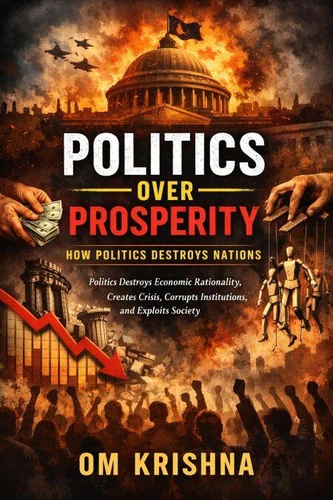
Politics Over Prosperity: How Politics Destroys Nations
Par :Formats :
Disponible dans votre compte client Decitre ou Furet du Nord dès validation de votre commande. Le format ePub est :
- Compatible avec une lecture sur My Vivlio (smartphone, tablette, ordinateur)
- Compatible avec une lecture sur liseuses Vivlio
- Pour les liseuses autres que Vivlio, vous devez utiliser le logiciel Adobe Digital Edition. Non compatible avec la lecture sur les liseuses Kindle, Remarkable et Sony
 , qui est-ce ?
Notre partenaire de plateforme de lecture numérique où vous retrouverez l'ensemble de vos ebooks gratuitement
Pour en savoir plus sur nos ebooks, consultez notre aide en ligne ici
C'est si simple ! Lisez votre ebook avec l'app Vivlio sur votre tablette, mobile ou ordinateur :

- FormatePub
- ISBN8233106033
- EAN9798233106033
- Date de parution26/02/2026
- Protection num.pas de protection
- Infos supplémentairesepub
- ÉditeurLinda Balsamo
Résumé
Politics Over Prosperity: How Politics Destroys Nations is a rigorous exploration of the complex relationship between political power and economic development in the twenty-first century. The book examines how political incentives, institutional design, and governance structures influence national prosperity, arguing that economic success is not determined solely by natural resources, markets, or technology, but by the quality and credibility of institutions.
Drawing inspiration from institutional political economy debates such as those presented in Why Nations Fail, this work extends the discussion by analyzing how political systems can gradually distort economic rationality. It challenges the assumption that a democratic form of economic growth automatically guarantees stability and prosperity. The central argument of the book is that politics, when dominated by short-term survival incentives, can undermine long-term national development.
When political actors prioritize power consolidation, electoral advantage, or narrative control over economic efficiency, governance structures begin to exhibit signs of institutional decay. This decay may not always appear as a sudden collapse but often manifests as a slow erosion of transparency, accountability, and public trust. Through global comparative analysis, the book explores multiple political economy phenomena, including rent-seeking behavior, regulatory capture, populist fiscal expansion, media narrative influence, and elite dominance in policy formation.
It discusses how crisis conditions are sometimes produced or intensified by structural political motivations rather than purely external economic shocks. The book also introduces a framework for understanding how nations can escape institutional decline. Independent institutions, fiscal discipline, judicial autonomy, and transparent governance systems are presented as essential components of sustainable development.
The author emphasizes that prosperity is not a static achievement but a dynamic equilibrium that must be continuously protected through rule-based governance. The narrative moves beyond ideological debates and focuses on structural incentives that shape state behavior. It examines how centralized power structures can generate policy volatility, economic uncertainty, and social exploitation when institutional checks are weak.
Designed for scholars, policymakers, economists, political science students, and global readers interested in governance and development theory, this book offers a critical yet analytical perspective on modern political economy. Politics Over Prosperity ultimately argues that the future of nations will depend not on the scale of political authority, but on the strength of institutional constraints that ensure power serves productivity, social welfare, and long-term national stability.
Drawing inspiration from institutional political economy debates such as those presented in Why Nations Fail, this work extends the discussion by analyzing how political systems can gradually distort economic rationality. It challenges the assumption that a democratic form of economic growth automatically guarantees stability and prosperity. The central argument of the book is that politics, when dominated by short-term survival incentives, can undermine long-term national development.
When political actors prioritize power consolidation, electoral advantage, or narrative control over economic efficiency, governance structures begin to exhibit signs of institutional decay. This decay may not always appear as a sudden collapse but often manifests as a slow erosion of transparency, accountability, and public trust. Through global comparative analysis, the book explores multiple political economy phenomena, including rent-seeking behavior, regulatory capture, populist fiscal expansion, media narrative influence, and elite dominance in policy formation.
It discusses how crisis conditions are sometimes produced or intensified by structural political motivations rather than purely external economic shocks. The book also introduces a framework for understanding how nations can escape institutional decline. Independent institutions, fiscal discipline, judicial autonomy, and transparent governance systems are presented as essential components of sustainable development.
The author emphasizes that prosperity is not a static achievement but a dynamic equilibrium that must be continuously protected through rule-based governance. The narrative moves beyond ideological debates and focuses on structural incentives that shape state behavior. It examines how centralized power structures can generate policy volatility, economic uncertainty, and social exploitation when institutional checks are weak.
Designed for scholars, policymakers, economists, political science students, and global readers interested in governance and development theory, this book offers a critical yet analytical perspective on modern political economy. Politics Over Prosperity ultimately argues that the future of nations will depend not on the scale of political authority, but on the strength of institutional constraints that ensure power serves productivity, social welfare, and long-term national stability.