SOLDES
Jusqu'à -70% sur une sélection d'articles*

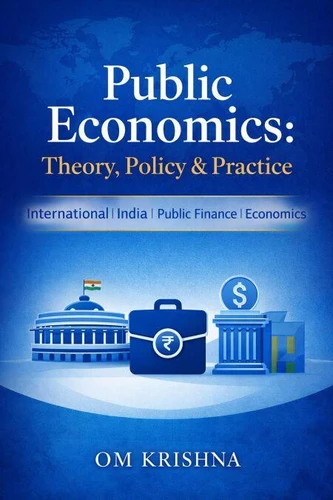
Public Economics: Theory, Policy, and Practice
Par :Formats :
Disponible dans votre compte client Decitre ou Furet du Nord dès validation de votre commande. Le format ePub est :
- Compatible avec une lecture sur My Vivlio (smartphone, tablette, ordinateur)
- Compatible avec une lecture sur liseuses Vivlio
- Pour les liseuses autres que Vivlio, vous devez utiliser le logiciel Adobe Digital Edition. Non compatible avec la lecture sur les liseuses Kindle, Remarkable et Sony
 , qui est-ce ?
Notre partenaire de plateforme de lecture numérique où vous retrouverez l'ensemble de vos ebooks gratuitement
Pour en savoir plus sur nos ebooks, consultez notre aide en ligne ici
C'est si simple ! Lisez votre ebook avec l'app Vivlio sur votre tablette, mobile ou ordinateur :

- FormatePub
- ISBN8232502645
- EAN9798232502645
- Date de parution07/02/2026
- Protection num.pas de protection
- Infos supplémentairesepub
- ÉditeurDraft2Digital
Résumé
Public Economics: Theory, Policy, and Contemporary Perspectives offers a comprehensive and analytically rigorous treatment of the economic role of the state in a modern economy. Designed for advanced undergraduate, postgraduate, and competitive examination candidates, this book integrates foundational theory with real-world policy applications and contemporary global debates. The book systematically develops public economics within the classical Samuelson-Musgrave-Ramsey-Mirrlees framework, covering public goods, market failure, welfare economics, taxation, public expenditure, fiscal federalism, budgeting, public debt, and fiscal rules.
At the same time, it extends beyond traditional public finance by incorporating modern institutional, political economy, and inequality perspectives relevant to the 21st century. Special emphasis is placed on India's fiscal system, including GST, intergovernmental transfers, budgeting processes, social sector spending, digital public finance, and post-COVID fiscal challenges. Comparative international experiences from the USA, EU, Germany, Chile, Brazil, and other economies are used to contextualize Indian public policy within global best practices.
The book stands out through its extensive use of current case studies, including COVID-19 fiscal stimulus, digital public infrastructure (UPI), GST compensation disputes, electoral freebies, carbon markets, and sovereign debt crises. These case studies demonstrate how public economics operates under real-world constraints such as political incentives, institutional capacity, crises, and uncertainty.
A distinctive feature of this volume is its set of internationally oriented appendices, which address fiscal rules, independent fiscal institutions, escape clauses during crises, sovereign debt sustainability, and performance budgeting failures across countries. The book also includes a dedicated chapter on contemporary economists-such as Robert J. Barro, Thomas J. Sargent, Olivier Blanchard, Alberto Alesina, Thomas Piketty, Douglass North, Elinor Ostrom, and Amartya Sen-situating their contributions as extensions to core public economics rather than as substitutes.
Written in clear, structured, and exam-relevant language, the book balances theoretical rigor with policy relevance. Diagrams, analytical explanations, and conceptual clarity make it suitable both for competitive examinations (UPSC Economics Optional, UGC-NET/JRF, GATE Economics) and for university courses in public finance, public policy, and development economics. By combining classical theory, modern fiscal institutions, and contemporary global challenges, Public Economics: Theory, Policy, and Contemporary Perspectives provides a unified and future-ready understanding of public economics in an era marked by pandemics, climate change, digital governance, and fiscal stress.
At the same time, it extends beyond traditional public finance by incorporating modern institutional, political economy, and inequality perspectives relevant to the 21st century. Special emphasis is placed on India's fiscal system, including GST, intergovernmental transfers, budgeting processes, social sector spending, digital public finance, and post-COVID fiscal challenges. Comparative international experiences from the USA, EU, Germany, Chile, Brazil, and other economies are used to contextualize Indian public policy within global best practices.
The book stands out through its extensive use of current case studies, including COVID-19 fiscal stimulus, digital public infrastructure (UPI), GST compensation disputes, electoral freebies, carbon markets, and sovereign debt crises. These case studies demonstrate how public economics operates under real-world constraints such as political incentives, institutional capacity, crises, and uncertainty.
A distinctive feature of this volume is its set of internationally oriented appendices, which address fiscal rules, independent fiscal institutions, escape clauses during crises, sovereign debt sustainability, and performance budgeting failures across countries. The book also includes a dedicated chapter on contemporary economists-such as Robert J. Barro, Thomas J. Sargent, Olivier Blanchard, Alberto Alesina, Thomas Piketty, Douglass North, Elinor Ostrom, and Amartya Sen-situating their contributions as extensions to core public economics rather than as substitutes.
Written in clear, structured, and exam-relevant language, the book balances theoretical rigor with policy relevance. Diagrams, analytical explanations, and conceptual clarity make it suitable both for competitive examinations (UPSC Economics Optional, UGC-NET/JRF, GATE Economics) and for university courses in public finance, public policy, and development economics. By combining classical theory, modern fiscal institutions, and contemporary global challenges, Public Economics: Theory, Policy, and Contemporary Perspectives provides a unified and future-ready understanding of public economics in an era marked by pandemics, climate change, digital governance, and fiscal stress.