SOLDES
Jusqu'à -70% sur une sélection d'articles*

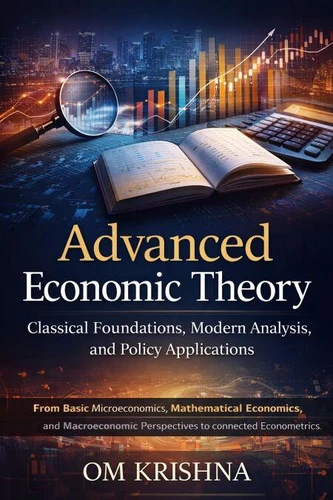
Advanced Economic Theory: Classical Foundations, Modern Analysis, and Policy Applications
Par :Formats :
Disponible dans votre compte client Decitre ou Furet du Nord dès validation de votre commande. Le format ePub est :
- Compatible avec une lecture sur My Vivlio (smartphone, tablette, ordinateur)
- Compatible avec une lecture sur liseuses Vivlio
- Pour les liseuses autres que Vivlio, vous devez utiliser le logiciel Adobe Digital Edition. Non compatible avec la lecture sur les liseuses Kindle, Remarkable et Sony
 , qui est-ce ?
Notre partenaire de plateforme de lecture numérique où vous retrouverez l'ensemble de vos ebooks gratuitement
Pour en savoir plus sur nos ebooks, consultez notre aide en ligne ici
C'est si simple ! Lisez votre ebook avec l'app Vivlio sur votre tablette, mobile ou ordinateur :

- FormatePub
- ISBN8233722219
- EAN9798233722219
- Date de parution20/02/2026
- Protection num.pas de protection
- Infos supplémentairesepub
- ÉditeurLinda Balsamo
Résumé
Advanced Economic Theory: Classical Foundations, Modern Analysis, and Policy Applications is a comprehensive and rigorously structured treatise designed for advanced students, researchers, civil service aspirants, and academic professionals seeking deep conceptual clarity and mathematical precision in economics. This book bridges the intellectual evolution of economic thought with contemporary analytical tools, offering an integrated framework that connects microeconomics, macroeconomics, mathematical economics, and econometrics into a coherent academic structure.
Beginning with the philosophical foundations and methodological debates in economics, the book revisits classical, neoclassical, Keynesian, and modern schools of thought, situating them within present-day policy realities. It systematically develops consumer theory, production theory, cost structures, market forms, welfare economics, and general equilibrium analysis using calculus-based derivations and graphical illustrations.
Each theoretical model is presented with mathematical rigor, ensuring conceptual clarity alongside analytical depth. The microeconomic section moves beyond textbook exposition by incorporating constrained optimization techniques, Lagrangian methods, duality theory, elasticity analysis, and advanced market structures, including monopoly, oligopoly, and game-theoretic frameworks. Mathematical proofs and logical derivations strengthen understanding while maintaining accessibility for serious learners.
In macroeconomics, the book develops income determination models from classical to Keynesian systems, the IS-LM framework, monetary transmission mechanisms, inflation dynamics, growth models, and open-economy macroeconomics. Analytical tools are applied to fiscal and monetary policy effectiveness, public debt sustainability, and structural transformation. The discussion integrates real-world policy debates, particularly in emerging economies, making theory operational and policy-relevant.
A distinctive feature of this work is its seamless transition into mathematical economics and econometric reasoning. Functions, optimization, comparative statics, matrix algebra, and dynamic systems are introduced as essential tools for economic modelling. The econometrics-oriented chapters connect theory with empirical validation, emphasizing regression analysis, hypothesis testing, and model interpretation, thus equipping readers to move from theoretical abstraction to measurable economic reality.
The book also emphasizes the role of economic theory in public policy formulation. Topics such as taxation, welfare redistribution, sustainable development, financial stability, and digital economic transformation are examined through theoretical lenses supported by analytical models. By linking abstract theory with contemporary governance challenges, the text demonstrates how economic reasoning informs institutional decision-making.
Beginning with the philosophical foundations and methodological debates in economics, the book revisits classical, neoclassical, Keynesian, and modern schools of thought, situating them within present-day policy realities. It systematically develops consumer theory, production theory, cost structures, market forms, welfare economics, and general equilibrium analysis using calculus-based derivations and graphical illustrations.
Each theoretical model is presented with mathematical rigor, ensuring conceptual clarity alongside analytical depth. The microeconomic section moves beyond textbook exposition by incorporating constrained optimization techniques, Lagrangian methods, duality theory, elasticity analysis, and advanced market structures, including monopoly, oligopoly, and game-theoretic frameworks. Mathematical proofs and logical derivations strengthen understanding while maintaining accessibility for serious learners.
In macroeconomics, the book develops income determination models from classical to Keynesian systems, the IS-LM framework, monetary transmission mechanisms, inflation dynamics, growth models, and open-economy macroeconomics. Analytical tools are applied to fiscal and monetary policy effectiveness, public debt sustainability, and structural transformation. The discussion integrates real-world policy debates, particularly in emerging economies, making theory operational and policy-relevant.
A distinctive feature of this work is its seamless transition into mathematical economics and econometric reasoning. Functions, optimization, comparative statics, matrix algebra, and dynamic systems are introduced as essential tools for economic modelling. The econometrics-oriented chapters connect theory with empirical validation, emphasizing regression analysis, hypothesis testing, and model interpretation, thus equipping readers to move from theoretical abstraction to measurable economic reality.
The book also emphasizes the role of economic theory in public policy formulation. Topics such as taxation, welfare redistribution, sustainable development, financial stability, and digital economic transformation are examined through theoretical lenses supported by analytical models. By linking abstract theory with contemporary governance challenges, the text demonstrates how economic reasoning informs institutional decision-making.