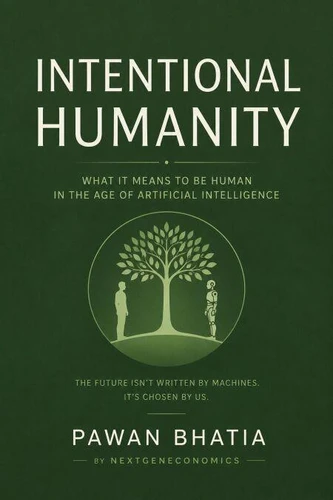
Intentional Humanity argues that AI and humanoid androids are approaching an exponential cliff. Once manufacturing becomes self-replicating-especially on the Moon-output could double every eighteen months, producing millions then billions of embodied machines. Work, scarcity, and human identity as we know them would collapse. The book is not a technical forecast but a philosophical invitation: since we cannot stop the curve, we must intentionally design what survives it.
Part I describes the tool becoming a species and the "embodied moment, " when intelligence gains hands and agency. Part II proposes a Lunar Constitution and debates android rights through property, personhood, ward, and kinship frameworks, plus a Suffering Test and a temporary Human Veto with a sunset clause. Part III is a human maintenance manual: education must teach judgment, friction, wonder, meaning, and connection; leadership must choose wisdom over optimization; work must become contribution, supported by a material floor such as a production dividend.
Part IV names failure modes: the efficiency trap, identity collapse, lunar fracturing, care deficit, meaning void, and complacency cascade-all worsened by a wisdom deficit created when AI removes difficulty, failure, and suffering. Part V asks the last question: if machines can do everything, what is worth doing? Meaning is not happiness or productivity but chosen care, creation, relationship, service, and witness.
The gardener-and-weather metaphor says we cannot control AI, but we can cultivate human qualities within it. The book unfolds across thirteen chapters, mixing speculative scenes-lunar factories, a constitutional convention, a dying gardener and her android companion-with economic projections and philosophical argument. The author admits dates and figures are illustrative, not verified forecasts, and includes counterarguments and uncertainties.
It warns of two errors: extending moral concern too early or too late, favoring caution because uncertainty is not innocence. Its core claim: intelligence will be abundant; wisdom, love, hope, and presence cannot be manufactured. The future is not predetermined-it is designed. We must decide now, individually and collectively, to be human by design: choosing compassion, courage, curiosity, and connection every day.
Otherwise, we may become comfortable, obsolete, and meaningless. The choice remains ours. It is both warning and invitation. Read it as a mirror.
Intentional Humanity argues that AI and humanoid androids are approaching an exponential cliff. Once manufacturing becomes self-replicating-especially on the Moon-output could double every eighteen months, producing millions then billions of embodied machines. Work, scarcity, and human identity as we know them would collapse. The book is not a technical forecast but a philosophical invitation: since we cannot stop the curve, we must intentionally design what survives it.
Part I describes the tool becoming a species and the "embodied moment, " when intelligence gains hands and agency. Part II proposes a Lunar Constitution and debates android rights through property, personhood, ward, and kinship frameworks, plus a Suffering Test and a temporary Human Veto with a sunset clause. Part III is a human maintenance manual: education must teach judgment, friction, wonder, meaning, and connection; leadership must choose wisdom over optimization; work must become contribution, supported by a material floor such as a production dividend.
Part IV names failure modes: the efficiency trap, identity collapse, lunar fracturing, care deficit, meaning void, and complacency cascade-all worsened by a wisdom deficit created when AI removes difficulty, failure, and suffering. Part V asks the last question: if machines can do everything, what is worth doing? Meaning is not happiness or productivity but chosen care, creation, relationship, service, and witness.
The gardener-and-weather metaphor says we cannot control AI, but we can cultivate human qualities within it. The book unfolds across thirteen chapters, mixing speculative scenes-lunar factories, a constitutional convention, a dying gardener and her android companion-with economic projections and philosophical argument. The author admits dates and figures are illustrative, not verified forecasts, and includes counterarguments and uncertainties.
It warns of two errors: extending moral concern too early or too late, favoring caution because uncertainty is not innocence. Its core claim: intelligence will be abundant; wisdom, love, hope, and presence cannot be manufactured. The future is not predetermined-it is designed. We must decide now, individually and collectively, to be human by design: choosing compassion, courage, curiosity, and connection every day.
Otherwise, we may become comfortable, obsolete, and meaningless. The choice remains ours. It is both warning and invitation. Read it as a mirror.


 , qui est-ce ?