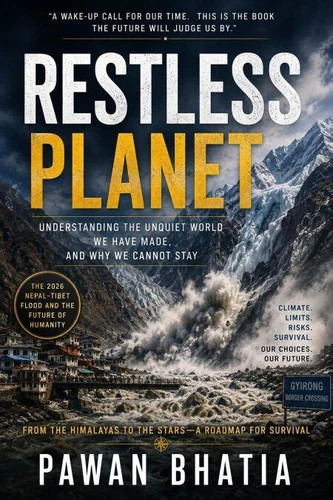
A 2026 Himalayan ice-rock avalanche flood-killing over 680, with thousands missing-opens Pawan Bhatia's Restless Planet, a synthesis of climate science, economic critique, and political psychology. The disaster at Langtang was no natural accident; it was a tipping point made inevitable by regional warming double the global average, permafrost thaw, and black-carbon soot, all documented in ICIMOD reports that governments ignored.
Bhatia traces two centuries of warnings-from Agassiz's ice-age theory to the Keeling Curve, the IPCC's assessments, and the eerily accurate Limits to Growth (1972) forecasts-showing how each generation received clear science and chose inaction. The book dissects the myth of infinite resources: freshwater depletion, soil erosion, biodiversity collapse (one million species face extinction), and the failure of "green growth" decoupling, since renewable minerals require destructive mining and consumption-based emissions remain untamed.
Civilizational case studies-Easter Island, the Maya, the Greenland Norse-reveal a recurring pattern: ecological overshoot, institutional rigidity, and collapse when societies refuse to adapt. Part Four confronts the space-colonization fantasy. While exoplanet discoveries number 5, 800+, even the nearest candidate lies light-years away, and a self-sustaining Mars colony would cost trillions-far exceeding the global clean-energy transition.
Bhatia calls this the "escape fallacy": a psychological evasion of Earth's urgent problems. Instead, existential risks-nuclear winter, engineered pandemics, uncontrolled AI-compound with climate disruption, yet the Doomsday Clock now stands at 85 seconds to midnight. The politics of denial occupy Part Five: fossil-fuel companies knew their own projections were accurate (Exxon's scientists matched Hansen's 1988 testimony) yet funded disinformation; media false balance and social-media algorithms reward outrage; cognitive biases-optimism, temporal discounting, identity protection-paralyze action.
Youth strikes and Indigenous stewardship offer hope, but treaties from Kyoto to Paris consistently underdeliver, with current pledges locking in 2.6-2.8°C warming. Finally, Part Six outlines a feasible transition: renewables now undercut fossil fuels, electric vehicles approach price parity, and early-warning systems save ten dollars for every dollar spent. Yet the gap remains political will, not technology.
Bhatia concludes that change is inevitable-chosen deliberately or imposed chaotically. The legacy of this generation, unlike past collapses, is one made with full knowledge. The restless planet will keep moving; what we build in response remains, valley by valley, election by election, the only question that genuinely matters.
A 2026 Himalayan ice-rock avalanche flood-killing over 680, with thousands missing-opens Pawan Bhatia's Restless Planet, a synthesis of climate science, economic critique, and political psychology. The disaster at Langtang was no natural accident; it was a tipping point made inevitable by regional warming double the global average, permafrost thaw, and black-carbon soot, all documented in ICIMOD reports that governments ignored.
Bhatia traces two centuries of warnings-from Agassiz's ice-age theory to the Keeling Curve, the IPCC's assessments, and the eerily accurate Limits to Growth (1972) forecasts-showing how each generation received clear science and chose inaction. The book dissects the myth of infinite resources: freshwater depletion, soil erosion, biodiversity collapse (one million species face extinction), and the failure of "green growth" decoupling, since renewable minerals require destructive mining and consumption-based emissions remain untamed.
Civilizational case studies-Easter Island, the Maya, the Greenland Norse-reveal a recurring pattern: ecological overshoot, institutional rigidity, and collapse when societies refuse to adapt. Part Four confronts the space-colonization fantasy. While exoplanet discoveries number 5, 800+, even the nearest candidate lies light-years away, and a self-sustaining Mars colony would cost trillions-far exceeding the global clean-energy transition.
Bhatia calls this the "escape fallacy": a psychological evasion of Earth's urgent problems. Instead, existential risks-nuclear winter, engineered pandemics, uncontrolled AI-compound with climate disruption, yet the Doomsday Clock now stands at 85 seconds to midnight. The politics of denial occupy Part Five: fossil-fuel companies knew their own projections were accurate (Exxon's scientists matched Hansen's 1988 testimony) yet funded disinformation; media false balance and social-media algorithms reward outrage; cognitive biases-optimism, temporal discounting, identity protection-paralyze action.
Youth strikes and Indigenous stewardship offer hope, but treaties from Kyoto to Paris consistently underdeliver, with current pledges locking in 2.6-2.8°C warming. Finally, Part Six outlines a feasible transition: renewables now undercut fossil fuels, electric vehicles approach price parity, and early-warning systems save ten dollars for every dollar spent. Yet the gap remains political will, not technology.
Bhatia concludes that change is inevitable-chosen deliberately or imposed chaotically. The legacy of this generation, unlike past collapses, is one made with full knowledge. The restless planet will keep moving; what we build in response remains, valley by valley, election by election, the only question that genuinely matters.


 , qui est-ce ?