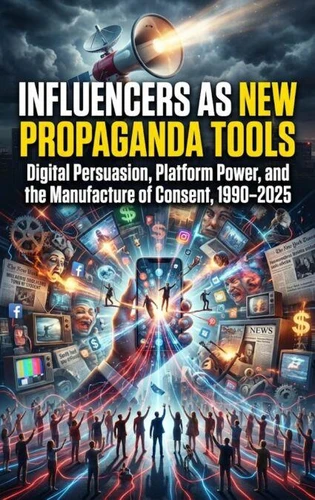
Influencers as New Propaganda Tools. Digital Persuasion, Platform Power, and the Manufacture of Consent, 1990–2025
Par :Formats :
Disponible dans votre compte client Decitre ou Furet du Nord dès validation de votre commande. Le format ePub est :
- Compatible avec une lecture sur My Vivlio (smartphone, tablette, ordinateur)
- Compatible avec une lecture sur liseuses Vivlio
- Pour les liseuses autres que Vivlio, vous devez utiliser le logiciel Adobe Digital Edition. Non compatible avec la lecture sur les liseuses Kindle, Remarkable et Sony
 , qui est-ce ?
Notre partenaire de plateforme de lecture numérique où vous retrouverez l'ensemble de vos ebooks gratuitement
Pour en savoir plus sur nos ebooks, consultez notre aide en ligne ici
C'est si simple ! Lisez votre ebook avec l'app Vivlio sur votre tablette, mobile ou ordinateur :

- Nombre de pages230
- FormatePub
- ISBN978-3-565-27469-7
- EAN9783565274697
- Date de parution26/02/2026
- Protection num.pas de protection
- Taille2 Mo
- Infos supplémentairesepub
- ÉditeurEmphaloz Publishing House
Résumé
They do not wear uniforms or carry party cards. They speak directly into your ear, recommend products, share opinions, and build communities of trust-sometimes numbering in the millions. Yet the influencer, for all their apparent spontaneity, is the latest iteration of one of history's oldest instruments: the trusted voice deployed in service of a larger agenda. Influencers as New Propaganda Tools examines how digital creators became the most effective persuasion infrastructure of the early twenty-first century.
This book traces the genealogy of influence from wartime celebrity endorsements and Cold War cultural diplomacy to the rise of social media platforms that gamified attention and monetized belief.
It shows how state actors, corporations, and political campaigns discovered that authentic-seeming personal voices outperform traditional advertising and institutional messaging by orders of magnitude-and how entire influence industries were quietly built around that discovery. Drawing on platform data, declassified influence operation reports, and the testimony of former campaign strategists, this is a rigorous and timely history of how consent is manufactured in the age of the algorithm-and why the most effective propaganda no longer looks like propaganda at all.
It shows how state actors, corporations, and political campaigns discovered that authentic-seeming personal voices outperform traditional advertising and institutional messaging by orders of magnitude-and how entire influence industries were quietly built around that discovery. Drawing on platform data, declassified influence operation reports, and the testimony of former campaign strategists, this is a rigorous and timely history of how consent is manufactured in the age of the algorithm-and why the most effective propaganda no longer looks like propaganda at all.
A propos de Alina Frost
















8,99 €