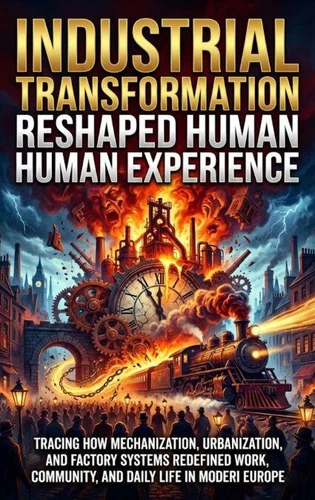
Industrial Transformation Reshaped Human Experience. Tracing How Mechanization, Urbanization, and Factory Systems Redefined Work, Community, and Daily Life in Modern Europe
Par :Formats :
Disponible dans votre compte client Decitre ou Furet du Nord dès validation de votre commande. Le format ePub est :
- Compatible avec une lecture sur My Vivlio (smartphone, tablette, ordinateur)
- Compatible avec une lecture sur liseuses Vivlio
- Pour les liseuses autres que Vivlio, vous devez utiliser le logiciel Adobe Digital Edition. Non compatible avec la lecture sur les liseuses Kindle, Remarkable et Sony
 , qui est-ce ?
Notre partenaire de plateforme de lecture numérique où vous retrouverez l'ensemble de vos ebooks gratuitement
Pour en savoir plus sur nos ebooks, consultez notre aide en ligne ici
C'est si simple ! Lisez votre ebook avec l'app Vivlio sur votre tablette, mobile ou ordinateur :

- Nombre de pages230
- FormatePub
- ISBN978-3-565-21663-5
- EAN9783565216635
- Date de parution01/02/2026
- Protection num.pas de protection
- Taille2 Mo
- Infos supplémentairesepub
- ÉditeurEmphaloz Publishing House
Résumé
The Industrial Revolution was not merely technological progress-it was a fundamental restructuring of how people lived, worked, and understood their place in society. This book examines how mechanization transformed social relationships, urban environments, and individual experiences across 18th and 19th century Europe, moving beyond factory machinery to explore human consequences.
Drawing on workers' letters, factory records, parliamentary inquiries, and material culture, the narrative traces how industrialization disrupted rural communities, created new urban poverty, and reshaped family structures.
Factory discipline replaced agricultural rhythms, child labor became economic necessity, and pollution transformed cityscapes. Yet workers also organized, negotiated, and resisted-developing unions, mutual aid societies, and political movements. The book explores how different social classes experienced transformation: entrepreneurs accumulating capital, artisans losing autonomy, women entering wage labor, children working machines.
Through analysis of wage books, housing conditions, and firsthand testimony, it reveals the institutional and personal disruptions that accompanied economic growth. Relevant for understanding how technological change creates winners and losers, and how societies navigate the human costs of progress when efficiency logic overrides community welfare.
Factory discipline replaced agricultural rhythms, child labor became economic necessity, and pollution transformed cityscapes. Yet workers also organized, negotiated, and resisted-developing unions, mutual aid societies, and political movements. The book explores how different social classes experienced transformation: entrepreneurs accumulating capital, artisans losing autonomy, women entering wage labor, children working machines.
Through analysis of wage books, housing conditions, and firsthand testimony, it reveals the institutional and personal disruptions that accompanied economic growth. Relevant for understanding how technological change creates winners and losers, and how societies navigate the human costs of progress when efficiency logic overrides community welfare.
A propos de Alina Frost















8,99 €