Gideon Hart is a nonfiction author who writes about leadership, philosophy, and the psychology of decision-making. His work explores how discipline, resilience, and long-term thinking shape both personal growth and success in times of uncertainty.
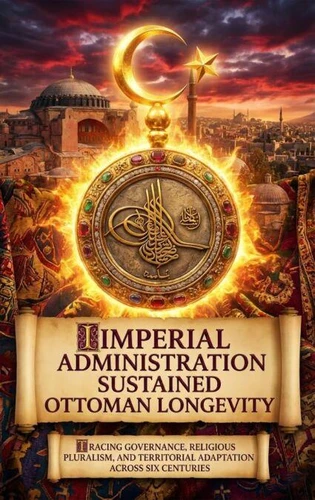
Imperial Administration Sustained Ottoman Longevity. Tracing Governance, Religious Pluralism, and Territorial Adaptation Across Six Centuries
Par :Formats :
Disponible dans votre compte client Decitre ou Furet du Nord dès validation de votre commande. Le format ePub est :
- Compatible avec une lecture sur My Vivlio (smartphone, tablette, ordinateur)
- Compatible avec une lecture sur liseuses Vivlio
- Pour les liseuses autres que Vivlio, vous devez utiliser le logiciel Adobe Digital Edition. Non compatible avec la lecture sur les liseuses Kindle, Remarkable et Sony
 , qui est-ce ?
Notre partenaire de plateforme de lecture numérique où vous retrouverez l'ensemble de vos ebooks gratuitement
Pour en savoir plus sur nos ebooks, consultez notre aide en ligne ici
C'est si simple ! Lisez votre ebook avec l'app Vivlio sur votre tablette, mobile ou ordinateur :

- Nombre de pages188
- FormatePub
- ISBN978-3-565-20760-2
- EAN9783565207602
- Date de parution29/01/2026
- Protection num.pas de protection
- Taille2 Mo
- Infos supplémentairesepub
- ÉditeurEmphaloz Publishing House
Résumé
The Ottoman Empire is often reduced to military conquest and eventual decline. Yet this rise-and-fall narrative overlooks what sustained an empire across six centuries and three continents: sophisticated administrative systems that adapted to diverse populations, legal frameworks balancing Islamic law with local customs, and diplomatic networks managing relationships with European powers, Persian rivals, and internal religious communities.
This book reexamines Ottoman governance through administrative records, court documents, tax registers, and diplomatic correspondence.
It traces how the empire integrated Christian and Jewish subjects through the millet system, how provincial governors negotiated between central authority and local realities, and how economic pressures-shifting trade routes, military costs, debt to European creditors-gradually undermined institutional capacity. By focusing on administrative practice rather than dramatic events, this work reveals the empire's actual mechanisms of survival and transformation.
It explores how Ottoman institutions managed religious diversity, territorial expansion, and eventual contraction-offering insight into the gap between imperial ambition and governmental reality. The question becomes: not why the empire fell, but how it endured as long as it did.
It traces how the empire integrated Christian and Jewish subjects through the millet system, how provincial governors negotiated between central authority and local realities, and how economic pressures-shifting trade routes, military costs, debt to European creditors-gradually undermined institutional capacity. By focusing on administrative practice rather than dramatic events, this work reveals the empire's actual mechanisms of survival and transformation.
It explores how Ottoman institutions managed religious diversity, territorial expansion, and eventual contraction-offering insight into the gap between imperial ambition and governmental reality. The question becomes: not why the empire fell, but how it endured as long as it did.