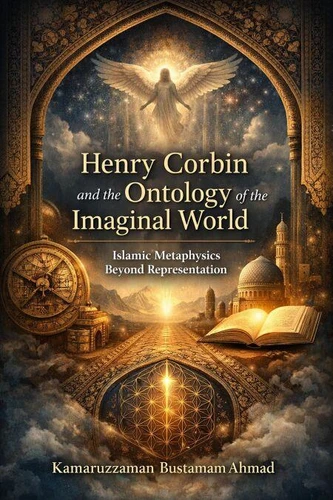
Henry Corbin and the Ontology of the Imaginal World: Islamic Metaphysics Beyond Representation
Par :Formats :
Disponible dans votre compte client Decitre ou Furet du Nord dès validation de votre commande. Le format ePub est :
- Compatible avec une lecture sur My Vivlio (smartphone, tablette, ordinateur)
- Compatible avec une lecture sur liseuses Vivlio
- Pour les liseuses autres que Vivlio, vous devez utiliser le logiciel Adobe Digital Edition. Non compatible avec la lecture sur les liseuses Kindle, Remarkable et Sony
 , qui est-ce ?
Notre partenaire de plateforme de lecture numérique où vous retrouverez l'ensemble de vos ebooks gratuitement
Pour en savoir plus sur nos ebooks, consultez notre aide en ligne ici
C'est si simple ! Lisez votre ebook avec l'app Vivlio sur votre tablette, mobile ou ordinateur :

- FormatePub
- ISBN8233279645
- EAN9798233279645
- Date de parution09/01/2026
- Protection num.pas de protection
- Infos supplémentairesepub
- ÉditeurLinda Balsamo
Résumé
Henry Corbin and the Ontology of the Imaginal World is a rigorous philosophical inquiry into one of the most overlooked yet decisive dimensions of Islamic metaphysics: the reality of the imaginal world (mundus imaginalis). Drawing deeply on the thought of Henry Corbin, this book explores imagination not as subjective fantasy, but as an ontological realm where meaning, symbol, and being converge. Modern philosophy has largely reduced imagination to psychology and representation, stripping it of metaphysical legitimacy.
Corbin's work offers a radical alternative. He restores imagination as a mode of reality-an intermediate world between the sensible and the intelligible-where spiritual knowledge unfolds through symbols, visions, and angelic mediation. This book situates Corbin's philosophy within the broader crisis of modern thought, where meaning has been eclipsed by abstraction, representation, and secular rationalism.
Rather than presenting Corbin as a historical figure alone, this study treats his work as a living metaphysical project. It examines how the imaginal world reshapes ontology, hermeneutics, anthropology, and ethics, offering a vision of Islamic metaphysics that transcends both positivism and theological literalism. The book argues that the denial of the imaginal realm lies at the heart of modern nihilism-and that its recovery is essential for any serious renewal of philosophy, religion, and spiritual knowledge.
Written in a clear yet scholarly style, Henry Corbin and the Ontology of the Imaginal World is not an introductory overview, but a sustained philosophical engagement. It is designed for readers who seek depth rather than simplification: scholars of Islamic philosophy, students of metaphysics, researchers of religion and modernity, and reflective readers searching for a framework beyond representation and reductionism.
This book positions Corbin's thought as a critical resource for the contemporary world-where imagination must be reclaimed not as escape, but as an organ of truth.
Corbin's work offers a radical alternative. He restores imagination as a mode of reality-an intermediate world between the sensible and the intelligible-where spiritual knowledge unfolds through symbols, visions, and angelic mediation. This book situates Corbin's philosophy within the broader crisis of modern thought, where meaning has been eclipsed by abstraction, representation, and secular rationalism.
Rather than presenting Corbin as a historical figure alone, this study treats his work as a living metaphysical project. It examines how the imaginal world reshapes ontology, hermeneutics, anthropology, and ethics, offering a vision of Islamic metaphysics that transcends both positivism and theological literalism. The book argues that the denial of the imaginal realm lies at the heart of modern nihilism-and that its recovery is essential for any serious renewal of philosophy, religion, and spiritual knowledge.
Written in a clear yet scholarly style, Henry Corbin and the Ontology of the Imaginal World is not an introductory overview, but a sustained philosophical engagement. It is designed for readers who seek depth rather than simplification: scholars of Islamic philosophy, students of metaphysics, researchers of religion and modernity, and reflective readers searching for a framework beyond representation and reductionism.
This book positions Corbin's thought as a critical resource for the contemporary world-where imagination must be reclaimed not as escape, but as an organ of truth.