
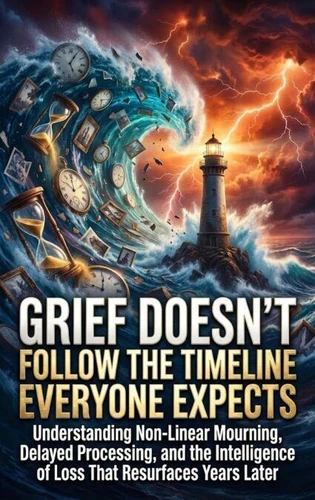
Grief Doesn't Follow the Timeline Everyone Expects. Understanding Non-Linear Mourning, Delayed Processing, and the Intelligence of Loss That Resurfaces Years Later
Par :Formats :
Disponible dans votre compte client Decitre ou Furet du Nord dès validation de votre commande. Le format ePub est :
- Compatible avec une lecture sur My Vivlio (smartphone, tablette, ordinateur)
- Compatible avec une lecture sur liseuses Vivlio
- Pour les liseuses autres que Vivlio, vous devez utiliser le logiciel Adobe Digital Edition. Non compatible avec la lecture sur les liseuses Kindle, Remarkable et Sony
 , qui est-ce ?
Notre partenaire de plateforme de lecture numérique où vous retrouverez l'ensemble de vos ebooks gratuitement
Pour en savoir plus sur nos ebooks, consultez notre aide en ligne ici
C'est si simple ! Lisez votre ebook avec l'app Vivlio sur votre tablette, mobile ou ordinateur :

- Nombre de pages155
- FormatePub
- ISBN978-3-565-21508-9
- EAN9783565215089
- Date de parution31/01/2026
- Protection num.pas de protection
- Taille2 Mo
- Infos supplémentairesepub
- ÉditeurEmphaloz Publishing House
Résumé
This book explores the often-misunderstood reality of grief that refuses to fit cultural timelines or predictable stages, examining why some losses feel manageable initially but intensify with time, why certain bereavements resurface unexpectedly years later, and what delayed or cyclical mourning reveals about how human nervous systems actually process profound loss. Rather than treating ongoing grief as incomplete healing, it investigates the intelligence of non-linear mourning, the protective function of delayed emotional processing, and why societal pressure to "move on" often conflicts with genuine psychological integration.
Through insights into trauma, attachment, and emotion processing, the book examines why grief can feel absent during acute loss but overwhelming during seemingly unrelated moments, how anniversary reactions and triggered memories reflect ongoing relationship with what was lost, and what persistent mourning reveals about the permanence of love rather than failure to heal.
It offers perspective on recognizing the difference between complicated grief requiring support and natural long-term processing, the validity of grief that others consider disproportionate or overdue, and how making space for cyclical mourning honors rather than pathologizes enduring connection. Grounded in bereavement research and compassionate witnessing, this is not about completing grief work or finding closure.
It's about understanding that lossintegrates into life at its own pace, resurfacing exactly when the nervous system has capacity to feel what couldn't be processed before.
It offers perspective on recognizing the difference between complicated grief requiring support and natural long-term processing, the validity of grief that others consider disproportionate or overdue, and how making space for cyclical mourning honors rather than pathologizes enduring connection. Grounded in bereavement research and compassionate witnessing, this is not about completing grief work or finding closure.
It's about understanding that lossintegrates into life at its own pace, resurfacing exactly when the nervous system has capacity to feel what couldn't be processed before.
A propos de Sarah Whitfield
















8,99 €