
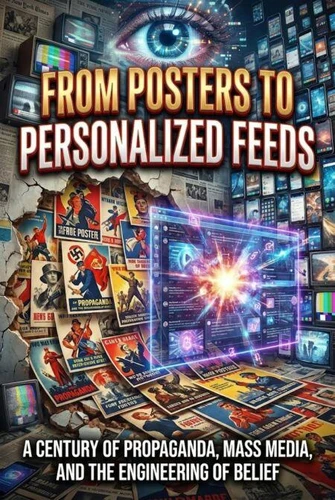
From Posters to Personalized Feeds. A Century of Propaganda, Mass Media, and the Engineering of Belief
Par :Formats :
Disponible dans votre compte client Decitre ou Furet du Nord dès validation de votre commande. Le format ePub est :
- Compatible avec une lecture sur My Vivlio (smartphone, tablette, ordinateur)
- Compatible avec une lecture sur liseuses Vivlio
- Pour les liseuses autres que Vivlio, vous devez utiliser le logiciel Adobe Digital Edition. Non compatible avec la lecture sur les liseuses Kindle, Remarkable et Sony
 , qui est-ce ?
Notre partenaire de plateforme de lecture numérique où vous retrouverez l'ensemble de vos ebooks gratuitement
Pour en savoir plus sur nos ebooks, consultez notre aide en ligne ici
C'est si simple ! Lisez votre ebook avec l'app Vivlio sur votre tablette, mobile ou ordinateur :

- Nombre de pages187
- FormatePub
- ISBN978-3-565-27463-5
- EAN9783565274635
- Date de parution26/02/2026
- Protection num.pas de protection
- Taille2 Mo
- Infos supplémentairesepub
- ÉditeurEmphaloz Publishing House
Résumé
The tools have changed beyond recognition. The intent has not. From Posters to Personalized Feeds traces the unbroken line connecting the lithographed war posters of 1914 to the algorithmically curated content streams of the twenty-first century-revealing how each new medium inherited, refined, and amplified the persuasion techniques of its predecessor.
This book examines propaganda not as an aberration of authoritarian regimes but as a structural feature of modern mass communication.
It follows the evolution of influence across six transformative moments: the print mobilization of the First World War, the radio empires of the interwar period, the cinematic machinery of fascist and Soviet states, the television age of the Cold War, the cable news fragmentation of the 1990s, and the micro-targeted digital ecosystems of today. At each stage, the same core mechanisms reappear-emotional priming, in-group identity, enemy construction, and the suppression of ambiguity. Drawing on archival propaganda materials, declassified government communication strategies, and media scholarship, this is an authoritative and accessible history of how mass belief is made-and what it costs when the engineering goes unexamined.
It follows the evolution of influence across six transformative moments: the print mobilization of the First World War, the radio empires of the interwar period, the cinematic machinery of fascist and Soviet states, the television age of the Cold War, the cable news fragmentation of the 1990s, and the micro-targeted digital ecosystems of today. At each stage, the same core mechanisms reappear-emotional priming, in-group identity, enemy construction, and the suppression of ambiguity. Drawing on archival propaganda materials, declassified government communication strategies, and media scholarship, this is an authoritative and accessible history of how mass belief is made-and what it costs when the engineering goes unexamined.
A propos de Sarah Whitfield














8,99 €