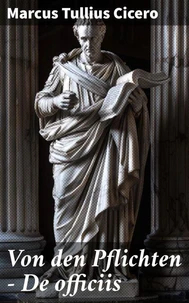
De Officiis
Par :Formats :
Disponible dans votre compte client Decitre ou Furet du Nord dès validation de votre commande. Le format ePub est :
- Compatible avec une lecture sur My Vivlio (smartphone, tablette, ordinateur)
- Compatible avec une lecture sur liseuses Vivlio
- Pour les liseuses autres que Vivlio, vous devez utiliser le logiciel Adobe Digital Edition. Non compatible avec la lecture sur les liseuses Kindle, Remarkable et Sony
 , qui est-ce ?
Notre partenaire de plateforme de lecture numérique où vous retrouverez l'ensemble de vos ebooks gratuitement
Pour en savoir plus sur nos ebooks, consultez notre aide en ligne ici
C'est si simple ! Lisez votre ebook avec l'app Vivlio sur votre tablette, mobile ou ordinateur :

- Nombre de pages716
- FormatePub
- ISBN978-3-7364-1359-7
- EAN9783736413597
- Date de parution06/09/2016
- Protection num.Digital Watermarking
- Taille602 Ko
- Infos supplémentairesepub
- ÉditeurAndhof
Résumé
In the de Officiis we have, save for the latter Philippics, the great orator's last contribution to literature. The last, sad, troubled years of his busy life could not be given to his profession; and he turned his never-resting thoughts to the second love of his student days and made Greek philosophy a possibility for Roman readers. The senate had been abolished; the courts had been closed. His occupation was gone; but Cicero could not surrender himself to idleness.
In those days of distraction (46-43 b.c.) he produced for publication almost as much as in all his years of active life. The liberators had been able to remove the tyrant, but they could not restore the republic. Cicero's own life was in danger from the fury of mad Antony and he left Rome about the end of March, 44 b.c. He dared not even stop permanently in any one of his various country estates, but, wretched, wandered from one of his villas to another nearly all the summer and autumn through.
He would not suffer himself to become a prey to his overwhelming sorrow at the death of the republic and the final crushing of the hopes that had risen with Caesar's downfall, but worked at the highest tension on his philosophical studies. The Romans were not philosophical. In 161 b.c. the senate passed a decree excluding all philosophers and teachers of rhetoric from the city. They had no taste for philosophical speculation, in which the Greeks were the world's masters.
They were intensely, narrowly practical. And Cicero was thoroughly [x] Roman. As a student in a Greek university he had had to study philosophy. His mind was broad enough and his soul great enough to give him a joy in following after the mighty masters, Socrates, Plato, Zeno, Cleanthes, Aristotle, Theophrastus, and the rest. But he pursued his study of it, like a Roman, from a "practical" motive-to promote thereby his power as an orator and to augment his success and happiness in life.
In those days of distraction (46-43 b.c.) he produced for publication almost as much as in all his years of active life. The liberators had been able to remove the tyrant, but they could not restore the republic. Cicero's own life was in danger from the fury of mad Antony and he left Rome about the end of March, 44 b.c. He dared not even stop permanently in any one of his various country estates, but, wretched, wandered from one of his villas to another nearly all the summer and autumn through.
He would not suffer himself to become a prey to his overwhelming sorrow at the death of the republic and the final crushing of the hopes that had risen with Caesar's downfall, but worked at the highest tension on his philosophical studies. The Romans were not philosophical. In 161 b.c. the senate passed a decree excluding all philosophers and teachers of rhetoric from the city. They had no taste for philosophical speculation, in which the Greeks were the world's masters.
They were intensely, narrowly practical. And Cicero was thoroughly [x] Roman. As a student in a Greek university he had had to study philosophy. His mind was broad enough and his soul great enough to give him a joy in following after the mighty masters, Socrates, Plato, Zeno, Cleanthes, Aristotle, Theophrastus, and the rest. But he pursued his study of it, like a Roman, from a "practical" motive-to promote thereby his power as an orator and to augment his success and happiness in life.