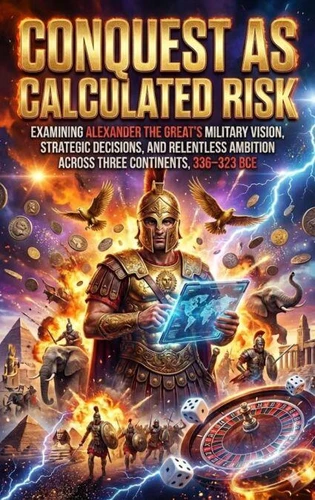
Conquest as Calculated Risk. Examining Alexander the Great's Military Vision, Strategic Decisions, and Relentless Ambition Across Three Continents, 336–323 BCE
Par :Formats :
Disponible dans votre compte client Decitre ou Furet du Nord dès validation de votre commande. Le format ePub est :
- Compatible avec une lecture sur My Vivlio (smartphone, tablette, ordinateur)
- Compatible avec une lecture sur liseuses Vivlio
- Pour les liseuses autres que Vivlio, vous devez utiliser le logiciel Adobe Digital Edition. Non compatible avec la lecture sur les liseuses Kindle, Remarkable et Sony
 , qui est-ce ?
Notre partenaire de plateforme de lecture numérique où vous retrouverez l'ensemble de vos ebooks gratuitement
Pour en savoir plus sur nos ebooks, consultez notre aide en ligne ici
C'est si simple ! Lisez votre ebook avec l'app Vivlio sur votre tablette, mobile ou ordinateur :

- Nombre de pages223
- FormatePub
- ISBN978-3-565-19895-5
- EAN9783565198955
- Date de parution27/01/2026
- Protection num.pas de protection
- Taille2 Mo
- Infos supplémentairesepub
- ÉditeurEmphaloz Publishing House
Résumé
Alexander of Macedon conquered an empire spanning from Greece to India in thirteen years-not through reckless bravery alone, but through calculated strategy, tactical adaptation, psychological warfare, and a willingness to risk everything on decisions that combined military genius with staggering audacity. His campaigns reveal a commander who studied terrain obsessively, exploited enemy weaknesses ruthlessly, and demanded loyalty through shared hardship and spectacular rewards.
This book traces Alexander's strategic thinking through specific campaigns that defined his reputation.
It examines his destruction of Thebes as a message to Greek cities contemplating rebellion, his crossing of the Hellespont with forces smaller than Persian advance units, his tactical innovations at Granicus and Issus that turned cavalry charges into precision instruments, and his siege of Tyre that demonstrated engineering capabilities beyond contemporary standards. It explores how he integrated conquered peoples into his army, adopted Persian administrative systems while maintaining Macedonian military culture, and pushed exhausted veterans beyond endurance toward goals they struggled to comprehend. Drawing on ancient sources-Arrian, Plutarch, Curtius-along with archaeological evidence from battle sites and conquered cities, it analyzes the gap between Alexander's self-image as divinely chosen and the pragmatic calculations that sustained conquest.
It examines how ambition became pathology as campaigns extended beyond strategic logic, how alcohol and paranoia poisoned relationships with trusted companions, and how empire-building collided with the physical limits of human endurance and administrative capacity. This is an exploration of how extraordinary military talent combined with insatiable ambition created an empire that collapsed immediately upon its architect's death.
It examines his destruction of Thebes as a message to Greek cities contemplating rebellion, his crossing of the Hellespont with forces smaller than Persian advance units, his tactical innovations at Granicus and Issus that turned cavalry charges into precision instruments, and his siege of Tyre that demonstrated engineering capabilities beyond contemporary standards. It explores how he integrated conquered peoples into his army, adopted Persian administrative systems while maintaining Macedonian military culture, and pushed exhausted veterans beyond endurance toward goals they struggled to comprehend. Drawing on ancient sources-Arrian, Plutarch, Curtius-along with archaeological evidence from battle sites and conquered cities, it analyzes the gap between Alexander's self-image as divinely chosen and the pragmatic calculations that sustained conquest.
It examines how ambition became pathology as campaigns extended beyond strategic logic, how alcohol and paranoia poisoned relationships with trusted companions, and how empire-building collided with the physical limits of human endurance and administrative capacity. This is an exploration of how extraordinary military talent combined with insatiable ambition created an empire that collapsed immediately upon its architect's death.
A propos de Alina Frost


















8,99 €