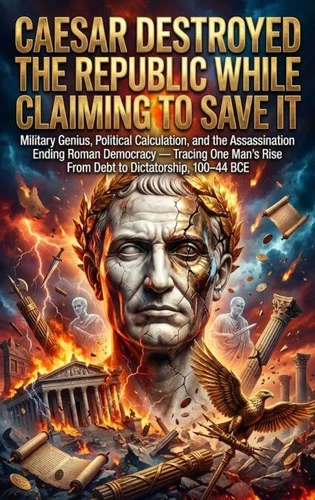
Caesar Destroyed the Republic While Claiming to Save It. Military Genius, Political Calculation, and the Assassination Ending Roman Democracy — Tracing One Man's Rise From Debt to Dictatorship, 100–44 BCE
Par :Formats :
Disponible dans votre compte client Decitre ou Furet du Nord dès validation de votre commande. Le format ePub est :
- Compatible avec une lecture sur My Vivlio (smartphone, tablette, ordinateur)
- Compatible avec une lecture sur liseuses Vivlio
- Pour les liseuses autres que Vivlio, vous devez utiliser le logiciel Adobe Digital Edition. Non compatible avec la lecture sur les liseuses Kindle, Remarkable et Sony
 , qui est-ce ?
Notre partenaire de plateforme de lecture numérique où vous retrouverez l'ensemble de vos ebooks gratuitement
Pour en savoir plus sur nos ebooks, consultez notre aide en ligne ici
C'est si simple ! Lisez votre ebook avec l'app Vivlio sur votre tablette, mobile ou ordinateur :

- Nombre de pages170
- FormatePub
- ISBN978-3-565-20334-5
- EAN9783565203345
- Date de parution28/01/2026
- Protection num.pas de protection
- Taille2 Mo
- Infos supplémentairesepub
- ÉditeurEmphaloz Publishing House
Résumé
Gaius Julius Caesar remains history's most examined paradox-brilliant general and ruthless autocrat, reformer and demagogue, victim of assassination and architect of his own murder. He crossed the Rubicon claiming to defend republican liberties while commanding legions against the Senate. He forgave enemies publicly while systematically eliminating political rivals. He refused the crown yet accumulated powers making monarchy inevitable.
Understanding Caesar requires separating the legend he crafted from the constitutional crisis he engineered. This book reconstructs Caesar's career through contemporary sources-Cicero's letters revealing senatorial panic, Caesar's own commentaries justifying Gallic conquest, Suetonius and Plutarch recording contradictory testimony about motives and character. It traces his calculated rise through debt-financed spectacle, strategic marriages, and the first triumvirate binding Pompey and Crassus to shared interests.
It follows the Gallic Wars as military genius and genocidal conquest, examining how battlefield success created veteran legions loyal to Caesar personally rather than to Rome.
Understanding Caesar requires separating the legend he crafted from the constitutional crisis he engineered. This book reconstructs Caesar's career through contemporary sources-Cicero's letters revealing senatorial panic, Caesar's own commentaries justifying Gallic conquest, Suetonius and Plutarch recording contradictory testimony about motives and character. It traces his calculated rise through debt-financed spectacle, strategic marriages, and the first triumvirate binding Pompey and Crassus to shared interests.
It follows the Gallic Wars as military genius and genocidal conquest, examining how battlefield success created veteran legions loyal to Caesar personally rather than to Rome.
A propos de Alina Frost

















8,99 €