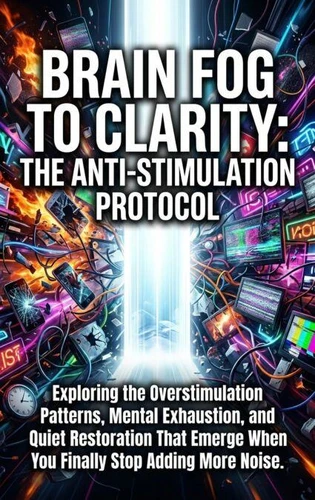
Brain Fog to Clarity: The Anti-Stimulation Protocol. Exploring the Overstimulation Patterns, Mental Exhaustion, and Quiet Restoration That Emerge When You Finally Stop Adding More Noise
Par :Formats :
Disponible dans votre compte client Decitre ou Furet du Nord dès validation de votre commande. Le format ePub est :
- Compatible avec une lecture sur My Vivlio (smartphone, tablette, ordinateur)
- Compatible avec une lecture sur liseuses Vivlio
- Pour les liseuses autres que Vivlio, vous devez utiliser le logiciel Adobe Digital Edition. Non compatible avec la lecture sur les liseuses Kindle, Remarkable et Sony
 , qui est-ce ?
Notre partenaire de plateforme de lecture numérique où vous retrouverez l'ensemble de vos ebooks gratuitement
Pour en savoir plus sur nos ebooks, consultez notre aide en ligne ici
C'est si simple ! Lisez votre ebook avec l'app Vivlio sur votre tablette, mobile ou ordinateur :

- Nombre de pages199
- FormatePub
- ISBN978-3-565-30421-9
- EAN9783565304219
- Date de parution08/03/2026
- Protection num.pas de protection
- Taille2 Mo
- Infos supplémentairesepub
- ÉditeurEmphaloz Publishing House
Résumé
Brain fog is rarely diagnosed and almost never taken seriously. It sits in the background of daily life as a kind of persistent dimness-the inability to think clearly, the effort it takes to focus on anything for longer than a few minutes, the sense that your mind is perpetually underwater. Most people assume it's tiredness. This book suggests it's something more specific than that.
It examines the relationship between chronic overstimulation and cognitive clarity-exploring how a nervous system saturated with constant input gradually loses its capacity for deep thought, sustained attention, and the kind of mental stillness that genuine creativity and decision-making require.
The fog, this book argues, isn't a malfunction. It's a reasonable response to an unreasonable amount of stimulation. This book offers honest insight into what reducing stimulation actually involves-not as a productivity protocol or a biohacking experiment, but as a genuine act of cognitive restoration. It explores the discomfort of the early withdrawal period, the unfamiliar quiet of an understimulated afternoon, and the slow, nonlinear return of mental clarity that follows when the noise is consistently reduced. Written without clinical detachment or wellness performance culture, this book reframes the anti-stimulation approach as something deeply personal-a quiet decision to stop overwhelming a mind that was never designed to process this much, this fast, without rest.
The fog, this book argues, isn't a malfunction. It's a reasonable response to an unreasonable amount of stimulation. This book offers honest insight into what reducing stimulation actually involves-not as a productivity protocol or a biohacking experiment, but as a genuine act of cognitive restoration. It explores the discomfort of the early withdrawal period, the unfamiliar quiet of an understimulated afternoon, and the slow, nonlinear return of mental clarity that follows when the noise is consistently reduced. Written without clinical detachment or wellness performance culture, this book reframes the anti-stimulation approach as something deeply personal-a quiet decision to stop overwhelming a mind that was never designed to process this much, this fast, without rest.