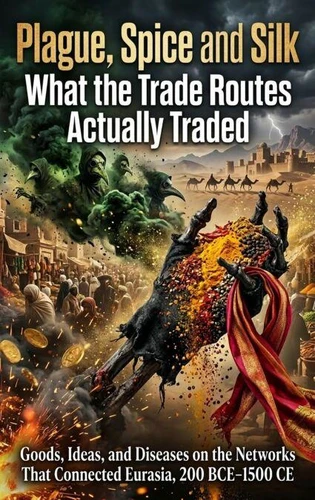
Plague, Spice and Silk: What the Trade Routes Actually Traded. Goods, Ideas, and Diseases on the Networks That Connected Eurasia, 200 BCE–1500 CE
Par :Formats :
Disponible dans votre compte client Decitre ou Furet du Nord dès validation de votre commande. Le format ePub est :
- Compatible avec une lecture sur My Vivlio (smartphone, tablette, ordinateur)
- Compatible avec une lecture sur liseuses Vivlio
- Pour les liseuses autres que Vivlio, vous devez utiliser le logiciel Adobe Digital Edition. Non compatible avec la lecture sur les liseuses Kindle, Remarkable et Sony
 , qui est-ce ?
Notre partenaire de plateforme de lecture numérique où vous retrouverez l'ensemble de vos ebooks gratuitement
Pour en savoir plus sur nos ebooks, consultez notre aide en ligne ici
C'est si simple ! Lisez votre ebook avec l'app Vivlio sur votre tablette, mobile ou ordinateur :

- Nombre de pages199
- FormatePub
- ISBN978-3-565-32694-5
- EAN9783565326945
- Date de parution15/03/2026
- Protection num.pas de protection
- Taille2 Mo
- Infos supplémentairesepub
- ÉditeurEmphaloz Publishing House
Résumé
The Silk Road was never a single road, nor only about silk. It was a web that carried merchants, monks, nomads, and pathogens between empires and across deserts for more than a millennium. Along its routes, history's most valuable commodities-spices, textiles, metals, and beliefs-moved together with something far less desired: disease.
This book uncovers what the Silk Road truly traded, blending archaeology, economic history, and bioarchaeology to reveal a system of exchange far richer and more complex than the romantic label suggests.
Through caravan accounts, shipwreck cargos, and genetic evidence, it traces how black pepper reached Rome, how Buddhist sutras traveled to China, and how the plague crossed from steppe rodents to Mediterranean ports. By following the movement of both wealth and contagion, the narrative exposes the Silk Road as the first global network-one that connected ecosystems as well as economies, and whose echoes still shape trade and health in our modern world.
Through caravan accounts, shipwreck cargos, and genetic evidence, it traces how black pepper reached Rome, how Buddhist sutras traveled to China, and how the plague crossed from steppe rodents to Mediterranean ports. By following the movement of both wealth and contagion, the narrative exposes the Silk Road as the first global network-one that connected ecosystems as well as economies, and whose echoes still shape trade and health in our modern world.