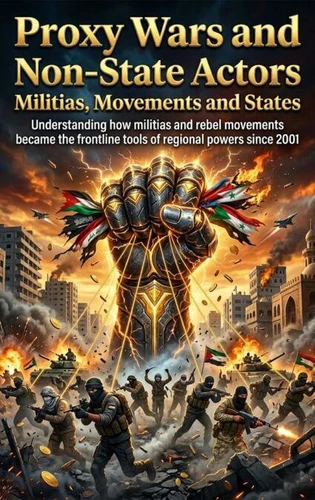
Proxy Wars and Non-State Actors: Militias, Movements and States. Understanding how militias and rebel movements became the frontline tools of regional powers since 2001
Par :Formats :
Disponible dans votre compte client Decitre ou Furet du Nord dès validation de votre commande. Le format ePub est :
- Compatible avec une lecture sur My Vivlio (smartphone, tablette, ordinateur)
- Compatible avec une lecture sur liseuses Vivlio
- Pour les liseuses autres que Vivlio, vous devez utiliser le logiciel Adobe Digital Edition. Non compatible avec la lecture sur les liseuses Kindle, Remarkable et Sony
 , qui est-ce ?
Notre partenaire de plateforme de lecture numérique où vous retrouverez l'ensemble de vos ebooks gratuitement
Pour en savoir plus sur nos ebooks, consultez notre aide en ligne ici
C'est si simple ! Lisez votre ebook avec l'app Vivlio sur votre tablette, mobile ou ordinateur :

- Nombre de pages165
- FormatePub
- ISBN978-3-565-37105-1
- EAN9783565371051
- Date de parution30/03/2026
- Protection num.pas de protection
- Taille2 Mo
- Infos supplémentairesepub
- ÉditeurEmphaloz Publishing House
Résumé
Since 9/11, the Middle East has become a laboratory of indirect conflict where state rivals fight through militias, insurgent movements, and sectarian networks rather than open armies. This book traces the rise of proxy wars from Afghanistan and Iraq to Syria, Yemen, and Gaza, showing how governments arm, fund, and direct local non-state actors to shape battlefield outcomes while preserving plausible deniability.
Drawing on modern history, contemporary conflict analysis, and frontline reporting, it unpacks how Iranian-backed Hezbollah and Kataib Hezbollah, U.
S.-supported Iraqi and Syrian opposition groups, Gulf-funded Islamist factions, and others turned tribal militias and religious movements into standing political-military forces. Instead of dry theory, it focuses on the lived realities of militants, their communities, and the civilians caught between sponsors and local agendas. Readers will gain a grounded understanding of how proxy relationships form, how they break down, and why they keep reshaping the Middle East's balance of power-without promises of easy solutions or "fixes."
S.-supported Iraqi and Syrian opposition groups, Gulf-funded Islamist factions, and others turned tribal militias and religious movements into standing political-military forces. Instead of dry theory, it focuses on the lived realities of militants, their communities, and the civilians caught between sponsors and local agendas. Readers will gain a grounded understanding of how proxy relationships form, how they break down, and why they keep reshaping the Middle East's balance of power-without promises of easy solutions or "fixes."