Nouveauté
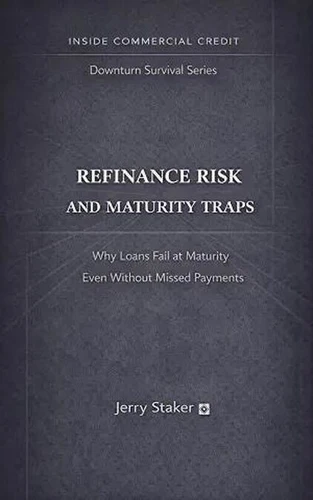
Book #8 – Refinance Risk and Maturity Traps: Why Loans Fail at Maturity Even Without Missed Payments. Inside Commercial Credit - Downturn Survival, #8
Par :Formats :
Disponible dans votre compte client Decitre ou Furet du Nord dès validation de votre commande. Le format ePub est :
- Compatible avec une lecture sur My Vivlio (smartphone, tablette, ordinateur)
- Compatible avec une lecture sur liseuses Vivlio
- Pour les liseuses autres que Vivlio, vous devez utiliser le logiciel Adobe Digital Edition. Non compatible avec la lecture sur les liseuses Kindle, Remarkable et Sony
 , qui est-ce ?
Notre partenaire de plateforme de lecture numérique où vous retrouverez l'ensemble de vos ebooks gratuitement
Pour en savoir plus sur nos ebooks, consultez notre aide en ligne ici
C'est si simple ! Lisez votre ebook avec l'app Vivlio sur votre tablette, mobile ou ordinateur :

- FormatePub
- ISBN8235097919
- EAN9798235097919
- Date de parution26/07/2026
- Protection num.pas de protection
- Infos supplémentairesepub
- ÉditeurIoakim Ioakim
Résumé
Many commercial loans do not fail because the borrower stops paying. They fail because the loan reaches maturity in a market that no longer supports refinancing. This is one of the most misunderstood risks in commercial credit. Borrowers assume that as long as payments are current and performance is acceptable, refinancing will remain available. Lenders know otherwise. Refinance windows open and close based on capital conditions, risk appetite, collateral values, and regulatory pressure - not borrower intent.
Refinance Risk and Maturity Traps explains why loans collapse at maturity even when nothing appears "wrong, " and how borrowers lose leverage long before the maturity date arrives. This book is not about missed payments. It is about timing and feasibility. It is also about how credit systems behave when capacity tightens - where refinancing becomes a function of market conditions and institutional constraint, not borrower performance or history.
Drawing on decades of commercial lending, credit risk, and workout experience, Jerry Staker shows how refinance risk is evaluated internally, why maturity becomes a trigger for re-underwriting, and how perfectly current loans are resized, downgraded, or denied extension when the numbers no longer work. Inside this book, you will learn: · Why maturity is one of the most dangerous moments in a loan's life· How refinance windows close suddenly - often without warning· How interest rate shocks destroy refinance feasibility· Why loans are resized at maturity even when payments are current· How market conditions override borrower performance· Why extensions replace refinancing - and what that signals· How refinance risk drives internal downgrades· What borrowers should prepare long before maturity· When refinancing is no longer an option· How last-minute collapse occurs - and how to avoid it· How to manage the inevitable when options narrowThis volume extends the series progression: after tools are applied (Book #7), timing becomes the constraint that determines whether options still exist.
Maturity is where internal risk classification, numeric feasibility, and market conditions converge into a single decision point. This book is written for small business owners, commercial real estate borrowers, guarantors, and stakeholders who believe maturity is a formality - until it isn't. Maturity does not reward good behavior. It tests feasibility. Borrowers who prepare early retain options.
Those who don't discover that the decision was made before the conversation began. In systems under strain, feasibility replaces intent - and timing determines whether alignment is still possible.
Refinance Risk and Maturity Traps explains why loans collapse at maturity even when nothing appears "wrong, " and how borrowers lose leverage long before the maturity date arrives. This book is not about missed payments. It is about timing and feasibility. It is also about how credit systems behave when capacity tightens - where refinancing becomes a function of market conditions and institutional constraint, not borrower performance or history.
Drawing on decades of commercial lending, credit risk, and workout experience, Jerry Staker shows how refinance risk is evaluated internally, why maturity becomes a trigger for re-underwriting, and how perfectly current loans are resized, downgraded, or denied extension when the numbers no longer work. Inside this book, you will learn: · Why maturity is one of the most dangerous moments in a loan's life· How refinance windows close suddenly - often without warning· How interest rate shocks destroy refinance feasibility· Why loans are resized at maturity even when payments are current· How market conditions override borrower performance· Why extensions replace refinancing - and what that signals· How refinance risk drives internal downgrades· What borrowers should prepare long before maturity· When refinancing is no longer an option· How last-minute collapse occurs - and how to avoid it· How to manage the inevitable when options narrowThis volume extends the series progression: after tools are applied (Book #7), timing becomes the constraint that determines whether options still exist.
Maturity is where internal risk classification, numeric feasibility, and market conditions converge into a single decision point. This book is written for small business owners, commercial real estate borrowers, guarantors, and stakeholders who believe maturity is a formality - until it isn't. Maturity does not reward good behavior. It tests feasibility. Borrowers who prepare early retain options.
Those who don't discover that the decision was made before the conversation began. In systems under strain, feasibility replaces intent - and timing determines whether alignment is still possible.