Nouveauté
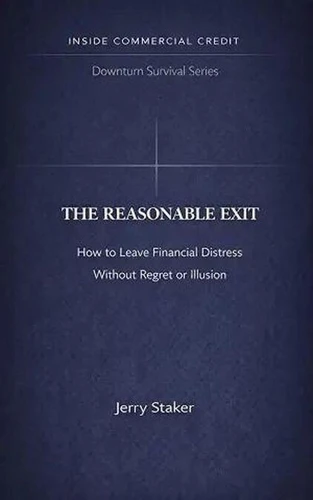
Book #12 – The Reasonable Exit: How to Leave Financial Distress Without Regret or Illusion. Inside Commercial Credit - Downturn Survival, #12
Par :Formats :
Disponible dans votre compte client Decitre ou Furet du Nord dès validation de votre commande. Le format ePub est :
- Compatible avec une lecture sur My Vivlio (smartphone, tablette, ordinateur)
- Compatible avec une lecture sur liseuses Vivlio
- Pour les liseuses autres que Vivlio, vous devez utiliser le logiciel Adobe Digital Edition. Non compatible avec la lecture sur les liseuses Kindle, Remarkable et Sony
 , qui est-ce ?
Notre partenaire de plateforme de lecture numérique où vous retrouverez l'ensemble de vos ebooks gratuitement
Pour en savoir plus sur nos ebooks, consultez notre aide en ligne ici
C'est si simple ! Lisez votre ebook avec l'app Vivlio sur votre tablette, mobile ou ordinateur :

- FormatePub
- ISBN8235916630
- EAN9798235916630
- Date de parution27/07/2026
- Protection num.pas de protection
- Infos supplémentairesepub
- ÉditeurIoakim Ioakim
Résumé
Every borrower facing financial distress eventually reaches a moment where effort, strategy, and negotiation stop being decisive. At that point, the outcome turns on judgment. The Reasonable Exit is the final book in the Inside Commercial Credit: Downturn Survival Series, and it addresses the most difficult question borrowers face:How do you know when it is time to stop fighting - and how do you exit without regret, illusion, or unnecessary damage?This book is not about tactics.
It is about standards. It formalizes the behavioral lens that runs throughout the entire series: the reasonable-man standard - the standard by which borrowers, lenders, regulators, and future counterparties ultimately evaluate conduct when systems are under strain. Drawing on decades of commercial lending, credit supervision, workouts, restructurings, and end-stage loan resolutions, Jerry Staker introduces the reasonable-man standard as the lens through which borrowers, lenders, regulators, courts, and future counterparties ultimately evaluate conduct during financial distress.
The reasonable-man standard does not ask whether a borrower tried hard enough. It asks whether the borrower adjusted behavior as reality changed. Inside this book, you will learn: · What the reasonable-man standard actually means in distressed credit· Why good faith is not emotional - but strategic· How lenders recognize reasonableness in borrower behavior· When continued negotiation becomes unreasonable· How denial and magical thinking quietly destroy outcomes· What integrity looks like under pressure· The lessons borrowers most often learn too late· How to survive financial distress without bitterness· How to rebuild credibility after failure· What you owe - and what you do not· How to make peace with an outcome you did not wantThis volume connects back across the series: perception (Book #2), structure (Book #3), numbers (Book #4), signals (Book #5), classification (Book #6), tools (Book #7), timing (Book #8), action (Book #9), constraint (Book #10), and resolution (Book #11) are all ultimately judged through reasonableness.
This book is written for small business owners, commercial borrowers, guarantors, and stakeholders who want to exit financial distress with clarity, dignity, and realism - not exhaustion, anger, or false narratives. The goal is not to avoid loss. The goal is to avoid avoidable regret. This is not a book about winning. It is a book about ending well. In constrained systems, outcomes are remembered less for what happened - and more for how they were handled.
It is about standards. It formalizes the behavioral lens that runs throughout the entire series: the reasonable-man standard - the standard by which borrowers, lenders, regulators, and future counterparties ultimately evaluate conduct when systems are under strain. Drawing on decades of commercial lending, credit supervision, workouts, restructurings, and end-stage loan resolutions, Jerry Staker introduces the reasonable-man standard as the lens through which borrowers, lenders, regulators, courts, and future counterparties ultimately evaluate conduct during financial distress.
The reasonable-man standard does not ask whether a borrower tried hard enough. It asks whether the borrower adjusted behavior as reality changed. Inside this book, you will learn: · What the reasonable-man standard actually means in distressed credit· Why good faith is not emotional - but strategic· How lenders recognize reasonableness in borrower behavior· When continued negotiation becomes unreasonable· How denial and magical thinking quietly destroy outcomes· What integrity looks like under pressure· The lessons borrowers most often learn too late· How to survive financial distress without bitterness· How to rebuild credibility after failure· What you owe - and what you do not· How to make peace with an outcome you did not wantThis volume connects back across the series: perception (Book #2), structure (Book #3), numbers (Book #4), signals (Book #5), classification (Book #6), tools (Book #7), timing (Book #8), action (Book #9), constraint (Book #10), and resolution (Book #11) are all ultimately judged through reasonableness.
This book is written for small business owners, commercial borrowers, guarantors, and stakeholders who want to exit financial distress with clarity, dignity, and realism - not exhaustion, anger, or false narratives. The goal is not to avoid loss. The goal is to avoid avoidable regret. This is not a book about winning. It is a book about ending well. In constrained systems, outcomes are remembered less for what happened - and more for how they were handled.