Nouveauté
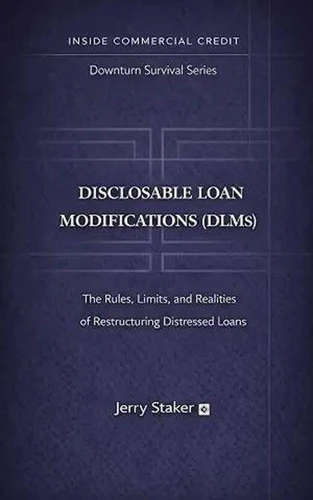
Book #10 – Disclosable Loan Modifications (DLMs): The Rules, Limits, and Realities of Restructuring Distressed Loans. Inside Commercial Credit - Downturn Survival, #10
Par :Formats :
Disponible dans votre compte client Decitre ou Furet du Nord dès validation de votre commande. Le format ePub est :
- Compatible avec une lecture sur My Vivlio (smartphone, tablette, ordinateur)
- Compatible avec une lecture sur liseuses Vivlio
- Pour les liseuses autres que Vivlio, vous devez utiliser le logiciel Adobe Digital Edition. Non compatible avec la lecture sur les liseuses Kindle, Remarkable et Sony
 , qui est-ce ?
Notre partenaire de plateforme de lecture numérique où vous retrouverez l'ensemble de vos ebooks gratuitement
Pour en savoir plus sur nos ebooks, consultez notre aide en ligne ici
C'est si simple ! Lisez votre ebook avec l'app Vivlio sur votre tablette, mobile ou ordinateur :

- FormatePub
- ISBN8235452749
- EAN9798235452749
- Date de parution26/07/2026
- Protection num.pas de protection
- Infos supplémentairesepub
- ÉditeurIoakim Ioakim
Résumé
When a commercial loan can no longer be repaid under its original terms, lenders do not improvise. They follow rules. Those rules are called Disclosable Loan Modifications (DLMs) - and they define what is possible, what is not, and why many borrower requests are rejected even when lenders want to help. Most borrowers misunderstand DLMs completely. They assume restructurings are negotiated freely, based on fairness, relationships, or intent.
In reality, every modification must satisfy accounting standards, regulatory expectations, internal credit policy, and documented repayment logic. When a proposal violates those constraints, it fails - regardless of sympathy or history. Disclosable Loan Modifications (DLMs) explains what these rules are, why they exist, and how borrowers can work within them instead of unknowingly disqualifying themselves.
This book is not about bargaining. It is about eligibility. It represents the point in the series where borrower proposals (Book #9) are formally tested against institutional constraints - where alignment is no longer conceptual, but codified in policy, accounting, and regulatory standards. Drawing on decades of hands-on experience in commercial and industrial lending, commercial real estate lending, special assets, and loan workouts, Jerry Staker explains how lenders evaluate restructuring requests, why certain tools are available, and what borrower behavior determines whether a DLM is even considered.
Inside this book, you will learn: · Why DLMs exist and what changed after TDR accounting ended· The four DLM tools lenders are permitted to use - and their limits· How principal forgiveness and charge-downs really work· When interest rate reductions are viable - and when they are not· How payment deferrals are evaluated under stress· What term extensions signal about loan viability· The borrower conditions required before any DLM is approved· How A/B notes function as a restructuring structure· What DLMs signal internally about your loan's future· The most common borrower mistakes that kill DLMs· How to use DLMs strategically - without crossing red linesThis volume reinforces the central framework of the series: when systems are under strain, solutions are constrained.
Borrowers who align with those constraints can propose viable paths forward. Those who do not are rejected regardless of intent. This book is written for small business owners, commercial real estate borrowers, guarantors, and stakeholders facing financial distress who need clarity - not optimism - about restructuring options. DLMs are not favors. They are constrained solutions. Borrowers who understand the rules can propose viable paths forward.
Those who do not are surprised when "reasonable" requests are declined. In distressed credit, alignment with constraint - not negotiation skill - determines what is possible.
In reality, every modification must satisfy accounting standards, regulatory expectations, internal credit policy, and documented repayment logic. When a proposal violates those constraints, it fails - regardless of sympathy or history. Disclosable Loan Modifications (DLMs) explains what these rules are, why they exist, and how borrowers can work within them instead of unknowingly disqualifying themselves.
This book is not about bargaining. It is about eligibility. It represents the point in the series where borrower proposals (Book #9) are formally tested against institutional constraints - where alignment is no longer conceptual, but codified in policy, accounting, and regulatory standards. Drawing on decades of hands-on experience in commercial and industrial lending, commercial real estate lending, special assets, and loan workouts, Jerry Staker explains how lenders evaluate restructuring requests, why certain tools are available, and what borrower behavior determines whether a DLM is even considered.
Inside this book, you will learn: · Why DLMs exist and what changed after TDR accounting ended· The four DLM tools lenders are permitted to use - and their limits· How principal forgiveness and charge-downs really work· When interest rate reductions are viable - and when they are not· How payment deferrals are evaluated under stress· What term extensions signal about loan viability· The borrower conditions required before any DLM is approved· How A/B notes function as a restructuring structure· What DLMs signal internally about your loan's future· The most common borrower mistakes that kill DLMs· How to use DLMs strategically - without crossing red linesThis volume reinforces the central framework of the series: when systems are under strain, solutions are constrained.
Borrowers who align with those constraints can propose viable paths forward. Those who do not are rejected regardless of intent. This book is written for small business owners, commercial real estate borrowers, guarantors, and stakeholders facing financial distress who need clarity - not optimism - about restructuring options. DLMs are not favors. They are constrained solutions. Borrowers who understand the rules can propose viable paths forward.
Those who do not are surprised when "reasonable" requests are declined. In distressed credit, alignment with constraint - not negotiation skill - determines what is possible.