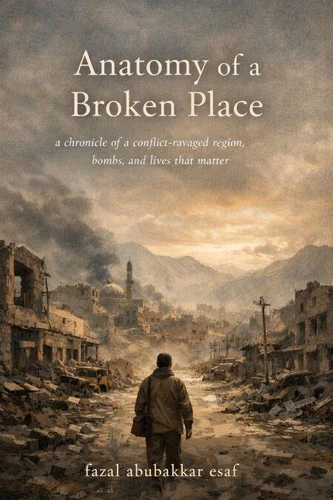
This book is not a history of a war. It is a record of what war does when it finishes speaking loudly. When the bombs stop, statistics take over. Numbers replace names. Briefings replace bread. The world moves on, and those who remain are told-implicitly-that survival should be gratitude enough. I wrote this book because that is not enough. Across interconnected chapters, Anatomy of a Broken Place follows civilians before impact, during chaos, and long after attention fades.
Each chapter opens with an artifact-something ordinary, damaged, or abandoned-to ground the story in material reality. Each ends with a Witness Note: not conclusions, not comfort, but testimony. This is not a neutral book. Neutrality, in the face of civilian suffering, is a position of power. Instead, this work attempts something harder: moral clarity without simplicity, empathy without absolution, and accountability without illusion.
There is no final redemption here. Only lessons, written at human cost, for those willing to read them.
This book is not a history of a war. It is a record of what war does when it finishes speaking loudly. When the bombs stop, statistics take over. Numbers replace names. Briefings replace bread. The world moves on, and those who remain are told-implicitly-that survival should be gratitude enough. I wrote this book because that is not enough. Across interconnected chapters, Anatomy of a Broken Place follows civilians before impact, during chaos, and long after attention fades.
Each chapter opens with an artifact-something ordinary, damaged, or abandoned-to ground the story in material reality. Each ends with a Witness Note: not conclusions, not comfort, but testimony. This is not a neutral book. Neutrality, in the face of civilian suffering, is a position of power. Instead, this work attempts something harder: moral clarity without simplicity, empathy without absolution, and accountability without illusion.
There is no final redemption here. Only lessons, written at human cost, for those willing to read them.

 , qui est-ce ?