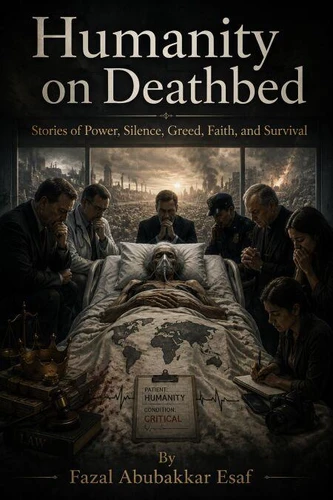
This is not a book about villains. Villains are easy to identify. They wear masks, carry weapons, and announce themselves loudly. The tragedy of our age is far more dangerous: ordinary people participating in extraordinary cruelty while believing themselves innocent. The stories in Humanity on Deathbed are not connected by characters, nations, or timelines. They are connected by something far more unsettling-recognition.
Somewhere inside these pages live systems we already know: corruption celebrated as patriotism, greed defended as success, hatred disguised as faith, silence mistaken for peace, and truth traded for convenience. Each chapter asks a question instead of offering comfort. What is victory when civilians burn?What is justice when truth has a price?What is faith when compassion disappears?What is democracy when hunger speaks louder than elections?These stories were written not to provide answers, but to disturb certainty.
Because humanity rarely collapses in a single moment. It erodes slowly-through compromises, excuses, distractions, and indifference. And yet, despite the darkness in these pages, this is not a hopeless book. The final voice in nearly every tragedy belongs not to power, but to conscience: a child asking questions, a stranger choosing kindness, a witness refusing silence, a human being remembering another human being.
If humanity is on its deathbed, perhaps honesty is still its medicine.- Fazal Abubakkar Esaf
This is not a book about villains. Villains are easy to identify. They wear masks, carry weapons, and announce themselves loudly. The tragedy of our age is far more dangerous: ordinary people participating in extraordinary cruelty while believing themselves innocent. The stories in Humanity on Deathbed are not connected by characters, nations, or timelines. They are connected by something far more unsettling-recognition.
Somewhere inside these pages live systems we already know: corruption celebrated as patriotism, greed defended as success, hatred disguised as faith, silence mistaken for peace, and truth traded for convenience. Each chapter asks a question instead of offering comfort. What is victory when civilians burn?What is justice when truth has a price?What is faith when compassion disappears?What is democracy when hunger speaks louder than elections?These stories were written not to provide answers, but to disturb certainty.
Because humanity rarely collapses in a single moment. It erodes slowly-through compromises, excuses, distractions, and indifference. And yet, despite the darkness in these pages, this is not a hopeless book. The final voice in nearly every tragedy belongs not to power, but to conscience: a child asking questions, a stranger choosing kindness, a witness refusing silence, a human being remembering another human being.
If humanity is on its deathbed, perhaps honesty is still its medicine.- Fazal Abubakkar Esaf


 , qui est-ce ?