SOLDES
Jusqu'à -70% sur une sélection d'articles*
- Accueil /
- Rutashubanyuma Nestory.
Rutashubanyuma Nestory.

Dernière sortie
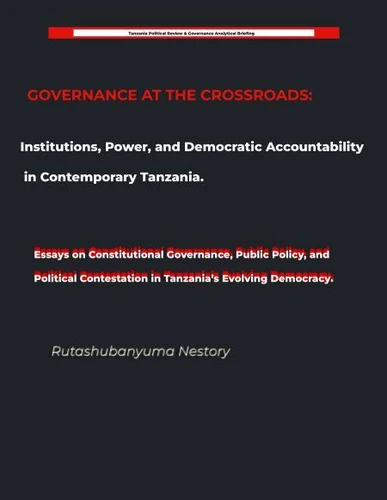
GOVERNANCE AT THE CROSSROADS Institutions, Power, and Democratic Accountability in Contemporary Tanzania
Tanzania's democratic experiment stands at a delicate crossroads-where constitutional promises, institutional practice, and political reality often diverge in ways that shape everyday governance and public life. Governance at the Crossroads offers a rigorous, wide-ranging examination of this tension. Through thirty-five carefully constructed essays, the volume explores how constitutional design interacts with executive discretion, how public policy is shaped by institutional capacity, and how democratic accountability is negotiated in practice rather than simply defined in law.
Spanning themes of constitutional reform, electoral integrity, fiscal governance, security regulation, regional integration, and political participation, the book moves beyond isolated policy debates to reveal deeper structural patterns in Tanzania's evolving state system. It shows how implementation gaps-rather than formal institutional absence-often define the limits of democratic consolidation.
Drawing on parliamentary records, legal frameworks, policy documents, and comparative African governance experiences, the analysis situates Tanzania within broader continental and global debates on democracy, sovereignty, and development. From public assembly regulation to infrastructure megaprojects, from health diplomacy to constitutional contestation, each chapter illuminates the friction between institutional ideals and political realities.
At its core, the book argues that Tanzania's governance challenges are not merely technical but structural: rooted in how power is exercised, how institutions interact, and how citizens engage with the state. Yet it also points toward possibilities for reform-through stronger institutional independence, clearer accountability mechanisms, and more meaningful political participation. Governance at the Crossroads is an essential contribution for scholars, policymakers, legal practitioners, and anyone interested in understanding the dynamics of African governance in transition.
Spanning themes of constitutional reform, electoral integrity, fiscal governance, security regulation, regional integration, and political participation, the book moves beyond isolated policy debates to reveal deeper structural patterns in Tanzania's evolving state system. It shows how implementation gaps-rather than formal institutional absence-often define the limits of democratic consolidation.
Drawing on parliamentary records, legal frameworks, policy documents, and comparative African governance experiences, the analysis situates Tanzania within broader continental and global debates on democracy, sovereignty, and development. From public assembly regulation to infrastructure megaprojects, from health diplomacy to constitutional contestation, each chapter illuminates the friction between institutional ideals and political realities.
At its core, the book argues that Tanzania's governance challenges are not merely technical but structural: rooted in how power is exercised, how institutions interact, and how citizens engage with the state. Yet it also points toward possibilities for reform-through stronger institutional independence, clearer accountability mechanisms, and more meaningful political participation. Governance at the Crossroads is an essential contribution for scholars, policymakers, legal practitioners, and anyone interested in understanding the dynamics of African governance in transition.
Tanzania's democratic experiment stands at a delicate crossroads-where constitutional promises, institutional practice, and political reality often diverge in ways that shape everyday governance and public life. Governance at the Crossroads offers a rigorous, wide-ranging examination of this tension. Through thirty-five carefully constructed essays, the volume explores how constitutional design interacts with executive discretion, how public policy is shaped by institutional capacity, and how democratic accountability is negotiated in practice rather than simply defined in law.
Spanning themes of constitutional reform, electoral integrity, fiscal governance, security regulation, regional integration, and political participation, the book moves beyond isolated policy debates to reveal deeper structural patterns in Tanzania's evolving state system. It shows how implementation gaps-rather than formal institutional absence-often define the limits of democratic consolidation.
Drawing on parliamentary records, legal frameworks, policy documents, and comparative African governance experiences, the analysis situates Tanzania within broader continental and global debates on democracy, sovereignty, and development. From public assembly regulation to infrastructure megaprojects, from health diplomacy to constitutional contestation, each chapter illuminates the friction between institutional ideals and political realities.
At its core, the book argues that Tanzania's governance challenges are not merely technical but structural: rooted in how power is exercised, how institutions interact, and how citizens engage with the state. Yet it also points toward possibilities for reform-through stronger institutional independence, clearer accountability mechanisms, and more meaningful political participation. Governance at the Crossroads is an essential contribution for scholars, policymakers, legal practitioners, and anyone interested in understanding the dynamics of African governance in transition.
Spanning themes of constitutional reform, electoral integrity, fiscal governance, security regulation, regional integration, and political participation, the book moves beyond isolated policy debates to reveal deeper structural patterns in Tanzania's evolving state system. It shows how implementation gaps-rather than formal institutional absence-often define the limits of democratic consolidation.
Drawing on parliamentary records, legal frameworks, policy documents, and comparative African governance experiences, the analysis situates Tanzania within broader continental and global debates on democracy, sovereignty, and development. From public assembly regulation to infrastructure megaprojects, from health diplomacy to constitutional contestation, each chapter illuminates the friction between institutional ideals and political realities.
At its core, the book argues that Tanzania's governance challenges are not merely technical but structural: rooted in how power is exercised, how institutions interact, and how citizens engage with the state. Yet it also points toward possibilities for reform-through stronger institutional independence, clearer accountability mechanisms, and more meaningful political participation. Governance at the Crossroads is an essential contribution for scholars, policymakers, legal practitioners, and anyone interested in understanding the dynamics of African governance in transition.
Les livres de Rutashubanyuma Nestory.
Nouveauté
Tanzania 2025 Contested Elections - Volume 1. Tanzania 2025 Contested Elections, #1
Rutashubanyuma Nestory.
E-book
6,49 €
Nouveauté

Tanzania Political Updates April (2026). Tanzania Political Updates, #4
Rutashubanyuma Nestory.
E-book
6,49 €
Nouveauté

Tanzania Political Updates February (2026). Tanzania Political Updates, #2
Rutashubanyuma Nestory.
E-book
6,49 €
Nouveauté

6,49 €

18,99 €