SOLDES
Jusqu'à -70% sur une sélection d'articles*
- Accueil /
- Emilia Carradine
Emilia Carradine

Dernière sortie
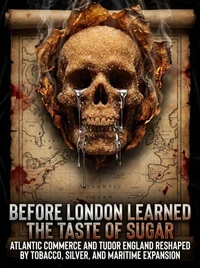
Before London Learned the Taste of Sugar
England did not cross the Atlantic unchanged. Long before formal empire hardened into policy, the arrival of tobacco, Caribbean sugar, and American silver transformed daily life across Tudor Britain. Markets expanded, old hierarchies weakened, and port cities began reorganizing themselves around distant oceans rather than nearby fields.
This book traces how commodities from the Americas altered economic and social structures throughout Atlantic Britain.
Imported goods once treated as luxuries gradually entered wider urban consumption, reshaping relationships between labor, status, and political influence. The profits of trans-Atlantic trade strengthened merchant families whose growing wealth challenged older forms of land-based authority rooted in feudal tradition. At the same time, maritime expansion forced the English Crown to redefine legal power at sea.
Royal charters, privateering licenses, and emerging naval doctrines blurred the line between commerce and sanctioned violence. Pirates could become patriotic agents when imperial competition demanded it. The Atlantic world therefore emerged not only through exploration, but through legal improvisation designed to secure trade routes and weaken rival empires. The result is a portrait of Tudor England as a society already becoming oceanic long before it fully understood the consequences of that transformation.
Imported goods once treated as luxuries gradually entered wider urban consumption, reshaping relationships between labor, status, and political influence. The profits of trans-Atlantic trade strengthened merchant families whose growing wealth challenged older forms of land-based authority rooted in feudal tradition. At the same time, maritime expansion forced the English Crown to redefine legal power at sea.
Royal charters, privateering licenses, and emerging naval doctrines blurred the line between commerce and sanctioned violence. Pirates could become patriotic agents when imperial competition demanded it. The Atlantic world therefore emerged not only through exploration, but through legal improvisation designed to secure trade routes and weaken rival empires. The result is a portrait of Tudor England as a society already becoming oceanic long before it fully understood the consequences of that transformation.
England did not cross the Atlantic unchanged. Long before formal empire hardened into policy, the arrival of tobacco, Caribbean sugar, and American silver transformed daily life across Tudor Britain. Markets expanded, old hierarchies weakened, and port cities began reorganizing themselves around distant oceans rather than nearby fields.
This book traces how commodities from the Americas altered economic and social structures throughout Atlantic Britain.
Imported goods once treated as luxuries gradually entered wider urban consumption, reshaping relationships between labor, status, and political influence. The profits of trans-Atlantic trade strengthened merchant families whose growing wealth challenged older forms of land-based authority rooted in feudal tradition. At the same time, maritime expansion forced the English Crown to redefine legal power at sea.
Royal charters, privateering licenses, and emerging naval doctrines blurred the line between commerce and sanctioned violence. Pirates could become patriotic agents when imperial competition demanded it. The Atlantic world therefore emerged not only through exploration, but through legal improvisation designed to secure trade routes and weaken rival empires. The result is a portrait of Tudor England as a society already becoming oceanic long before it fully understood the consequences of that transformation.
Imported goods once treated as luxuries gradually entered wider urban consumption, reshaping relationships between labor, status, and political influence. The profits of trans-Atlantic trade strengthened merchant families whose growing wealth challenged older forms of land-based authority rooted in feudal tradition. At the same time, maritime expansion forced the English Crown to redefine legal power at sea.
Royal charters, privateering licenses, and emerging naval doctrines blurred the line between commerce and sanctioned violence. Pirates could become patriotic agents when imperial competition demanded it. The Atlantic world therefore emerged not only through exploration, but through legal improvisation designed to secure trade routes and weaken rival empires. The result is a portrait of Tudor England as a society already becoming oceanic long before it fully understood the consequences of that transformation.
Les livres de Emilia Carradine
Nouveauté

Parliament beside Filth. British Political History amid Cholera Fear and Thames Pollution
Emilia Carradine
E-book
24,99 €
Nouveauté

9,99 €


8,99 €

9,99 €