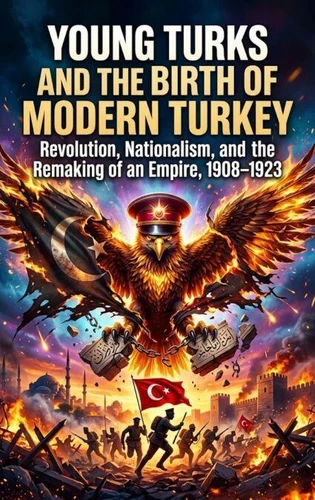
Young Turks and the Birth of Modern Turkey. Revolution, Nationalism, and the Remaking of an Empire, 1908–1923
Par :Formats :
Disponible dans votre compte client Decitre ou Furet du Nord dès validation de votre commande. Le format ePub est :
- Compatible avec une lecture sur My Vivlio (smartphone, tablette, ordinateur)
- Compatible avec une lecture sur liseuses Vivlio
- Pour les liseuses autres que Vivlio, vous devez utiliser le logiciel Adobe Digital Edition. Non compatible avec la lecture sur les liseuses Kindle, Remarkable et Sony
 , qui est-ce ?
Notre partenaire de plateforme de lecture numérique où vous retrouverez l'ensemble de vos ebooks gratuitement
Pour en savoir plus sur nos ebooks, consultez notre aide en ligne ici
C'est si simple ! Lisez votre ebook avec l'app Vivlio sur votre tablette, mobile ou ordinateur :

- Nombre de pages191
- FormatePub
- ISBN978-3-565-32290-9
- EAN9783565322909
- Date de parution14/03/2026
- Protection num.pas de protection
- Taille2 Mo
- Infos supplémentairesepub
- ÉditeurEmphaloz Publishing House
Résumé
In July 1908, a constitutional revolution forced the Ottoman sultan to restore parliamentary government - and the men who led it believed they had saved an empire. Within fifteen years, that empire was gone, replaced by a republic they had not intended to create, built on ruins they had helped produce. The Young Turks remain one of history's most consequential and contested revolutionary movements: modernizers who embraced ethnic nationalism, reformers who presided over genocide, and empire-savers who became nation-builders by necessity.
This book examines the Committee of Union and Progress - the Young Turk organization - as a political and ideological movement navigating an empire in terminal crisis.
It traces their intellectual formation in European exile, their seizure of power in 1908, and the increasingly authoritarian trajectory that followed: the suppression of minority populations, the catastrophic alliance with Germany in 1914, and the wartime deportations and massacres of Armenians, Assyrians, and Greeks that would define their historical legacy. It follows the movement's fragmentation after defeat - and how one of its junior officers, Mustafa Kemal, salvaged Turkish sovereignty from the wreckage. Drawing on Ottoman parliamentary records, CUP internal correspondence, European diplomatic archives, and survivor testimony, this is a rigorous account of how revolutionary ambition, nationalist ideology, and imperial collapse combined to produce the modern Turkish state.
It traces their intellectual formation in European exile, their seizure of power in 1908, and the increasingly authoritarian trajectory that followed: the suppression of minority populations, the catastrophic alliance with Germany in 1914, and the wartime deportations and massacres of Armenians, Assyrians, and Greeks that would define their historical legacy. It follows the movement's fragmentation after defeat - and how one of its junior officers, Mustafa Kemal, salvaged Turkish sovereignty from the wreckage. Drawing on Ottoman parliamentary records, CUP internal correspondence, European diplomatic archives, and survivor testimony, this is a rigorous account of how revolutionary ambition, nationalist ideology, and imperial collapse combined to produce the modern Turkish state.