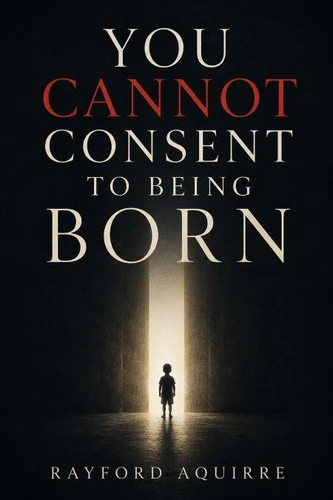
You never agreed to exist. But does that mean someone was wrong to create you?Before you were born, there was no one who could ask for your permission. No signature could be obtained. No refusal could be heard. Yet the decision to create a human life carries consequences more profound than almost any other choice one person can make for another. You Cannot Consent to Being Born examines the moral problem hidden inside one of humanity's most ordinary acts: procreation.
Rayford Aquirre confronts the strongest arguments on every side. Is birth a violation of consent - or is that concept meaningless before a person exists? Can existence truly benefit someone who would otherwise never have existed? How should prospective parents think about suffering, disability, uncertainty, and foreseeable risk? Does reproductive freedom settle the moral question? And what does choosing to create a dependent human being obligate a parent to provide afterward?Moving through the non-identity problem, antinatalism, reproductive liberty, wrongful-life arguments, future generations, parental authority, gratitude, and autonomy, the book rejects easy conclusions.
Its argument is more demanding: creating a person may be morally permissible without ever becoming morally trivial. Because the deepest question may not be whether parents have the right to create a life. It may be what they owe the person once that life becomes their own. That formulation tracks the manuscript's actual progression from consent and non-identity through risk, antinatalism, defenses of procreation, parental obligations, law, disability, and future persons.
You never agreed to exist. But does that mean someone was wrong to create you?Before you were born, there was no one who could ask for your permission. No signature could be obtained. No refusal could be heard. Yet the decision to create a human life carries consequences more profound than almost any other choice one person can make for another. You Cannot Consent to Being Born examines the moral problem hidden inside one of humanity's most ordinary acts: procreation.
Rayford Aquirre confronts the strongest arguments on every side. Is birth a violation of consent - or is that concept meaningless before a person exists? Can existence truly benefit someone who would otherwise never have existed? How should prospective parents think about suffering, disability, uncertainty, and foreseeable risk? Does reproductive freedom settle the moral question? And what does choosing to create a dependent human being obligate a parent to provide afterward?Moving through the non-identity problem, antinatalism, reproductive liberty, wrongful-life arguments, future generations, parental authority, gratitude, and autonomy, the book rejects easy conclusions.
Its argument is more demanding: creating a person may be morally permissible without ever becoming morally trivial. Because the deepest question may not be whether parents have the right to create a life. It may be what they owe the person once that life becomes their own. That formulation tracks the manuscript's actual progression from consent and non-identity through risk, antinatalism, defenses of procreation, parental obligations, law, disability, and future persons.