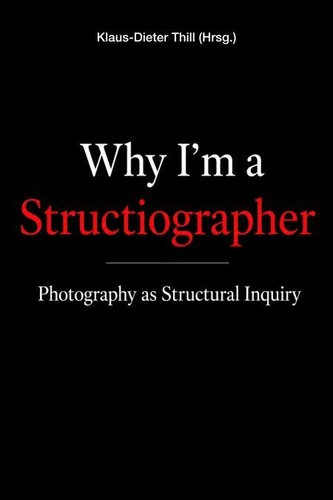
The author is the founder of "Structiography", a photographic art method devoted to making the formative relations of visible reality perceptible. His work explores how ordinary objects, spaces and traces can reveal the conditions through which situations are organised, sustained or transformed. *Why I'm a Structiographer* presents the conceptual foundation of this photographic position.
Nouveauté
Why I'm a Structiographer. Photography as Structural Inquiry
Par :Formats :
Disponible dans votre compte client Decitre ou Furet du Nord dès validation de votre commande. Le format ePub est :
- Compatible avec une lecture sur My Vivlio (smartphone, tablette, ordinateur)
- Compatible avec une lecture sur liseuses Vivlio
- Pour les liseuses autres que Vivlio, vous devez utiliser le logiciel Adobe Digital Edition. Non compatible avec la lecture sur les liseuses Kindle, Remarkable et Sony
 , qui est-ce ?
Notre partenaire de plateforme de lecture numérique où vous retrouverez l'ensemble de vos ebooks gratuitement
Pour en savoir plus sur nos ebooks, consultez notre aide en ligne ici
C'est si simple ! Lisez votre ebook avec l'app Vivlio sur votre tablette, mobile ou ordinateur :

- Nombre de pages47
- FormatePub
- ISBN978-3-565-50792-4
- EAN9783565507924
- Date de parution14/08/2026
- Protection num.Digital Watermarking
- Taille489 Ko
- Infos supplémentairesepub
- ÉditeurEmphaloz Publishing House
Résumé
What if photography could reveal not only what things look like, but the relations and conditions through which visible situations come into being?
In *Why I'm a Structiographer*, the author introduces **Structiography**, a photographic art method centred on structural inquiry. Starting from an apparently simple shift in attention-from object to relation, from appearance to condition-the book explores how boundaries, dependencies, traces, interruptions, temporary arrangements and changes of function can become photographically perceptible.
Structiography does not propose a new visual style, prescribe particular subjects or claim that structures have never been photographed before.
Its concern is more precise: to make **structural visibility** the primary intention of a photographic practice. Written as an accessible essay rather than an academic theory, the book also examines the limits of this approach. What can a photograph actually tell us? Where does observation become interpretation? When does interpretation turn into projection? And how can a photograph remain open to the viewer without becoming arbitrary? Through three carefully described Structiographic Scenes, the book develops a photographic position that sees ordinary reality differently.
A covered shop window becomes an altered system of visibility. A beam of light reveals a temporary relation between architecture, time and position. A human figure apparently emerging from paving stones raises the uncomfortable question of whether a structure has been discovered or created by the act of seeing. *Why I'm a Structiographer* is an invitation to photographers, artists and visually curious readers to reconsider what a photograph can investigate.
It proposes that appearance may be only the visible edge of a relation larger than itself, and that photography can give that relation a form.
Its concern is more precise: to make **structural visibility** the primary intention of a photographic practice. Written as an accessible essay rather than an academic theory, the book also examines the limits of this approach. What can a photograph actually tell us? Where does observation become interpretation? When does interpretation turn into projection? And how can a photograph remain open to the viewer without becoming arbitrary? Through three carefully described Structiographic Scenes, the book develops a photographic position that sees ordinary reality differently.
A covered shop window becomes an altered system of visibility. A beam of light reveals a temporary relation between architecture, time and position. A human figure apparently emerging from paving stones raises the uncomfortable question of whether a structure has been discovered or created by the act of seeing. *Why I'm a Structiographer* is an invitation to photographers, artists and visually curious readers to reconsider what a photograph can investigate.
It proposes that appearance may be only the visible edge of a relation larger than itself, and that photography can give that relation a form.